Lewis and Lipper-Garabedian to City Council and School Committee: State Can Help, But Only So Much
By Ellen Putnam
Screenshot from MMTV
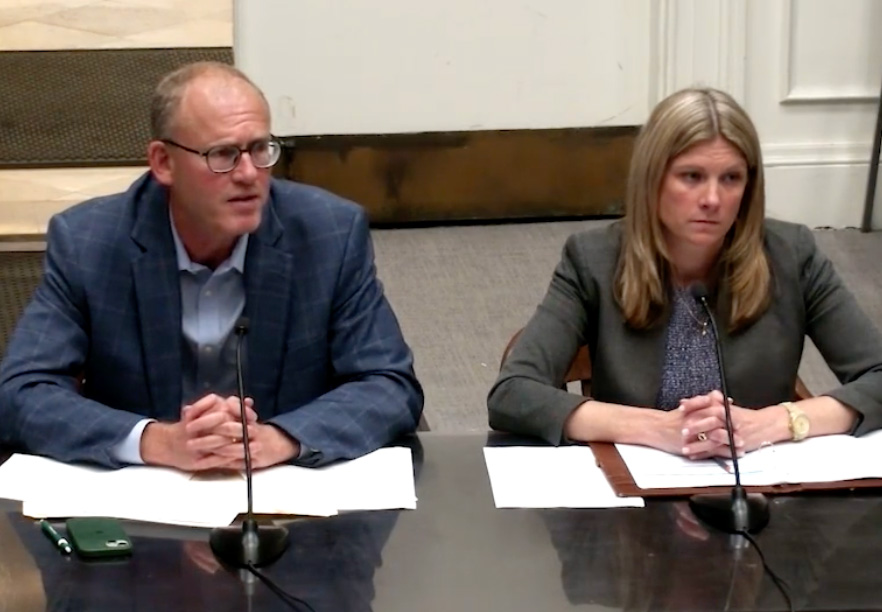
Last week, State Representative Kate Lipper-Garabedian and State Senator Jason Lewis spoke to a joint meeting of the City Council and the School Committee to share how they negotiated the amount of state aid Melrose received this year, and what Melrose can expect from the state going forward.
State funding for municipalities like Melrose falls into a few “buckets” (as Lipper-Garabedian called them). Chapter 70 funding for schools and Unrestricted General Government Aid, by far the largest sources of state aid for municipalities, are based on funding formulas. That means that our state delegation is unable to change funding specific to Melrose without affecting funding for all other municipalities and school districts in Massachusetts.
Cities and towns also receive specific earmarks that their state delegations secure, for designated projects and goals, but these are usually much smaller amounts of money. This year, for instance, Melrose received $550,000 in earmarks, compared to the over $21 million the city received in total state aid. Some of these earmarks came from revenue generated by the Fair Share Amendment (the “millionaires’ tax”), which comes from a Supplemental Budget that can be used only for education and transportation purposes.
Lewis explained the formula for Chapter 70 school funding. First, the state determines the total budget that a school district is expected to need to operate - the foundation budget - based on student enrollment. Then, the state calculates what it believes a city or town “can afford to contribute from its own revenue stream based on aggregate income and aggregate wealth.” The difference between those two numbers - the amount the school district is expected to need to spend and the amount it is expected to be able to contribute - is the amount of additional aid that the state will provide.
(More information about Chapter 70 funding, including data comparing Melrose to other school districts, can be found here.)
Lipper-Garabedian and Lewis noted that recently, under the state funding formula, Melrose became a minimum aid community.
“If the difference between those numbers is not large enough to generate additional aid,” explained Lewis, “then the community falls into the minimum aid category - since their costs are likely still going up, and they still need some help.”
“So what you’re saying,” said School Committee Member Jen McAndrew, “is that the state believes that, as compared to other cities and towns in Massachusetts, Melrose has the wealth it needs to fund its own government.”
Lipper-Garabedian agreed, noting, “Melrose is a bit of an outlier when it comes to our property tax scheme. We are in the bottom 20% in the entire state for property tax burden relative to our property values, and we are in the bottom third in property tax burden relative to our income per capita.”
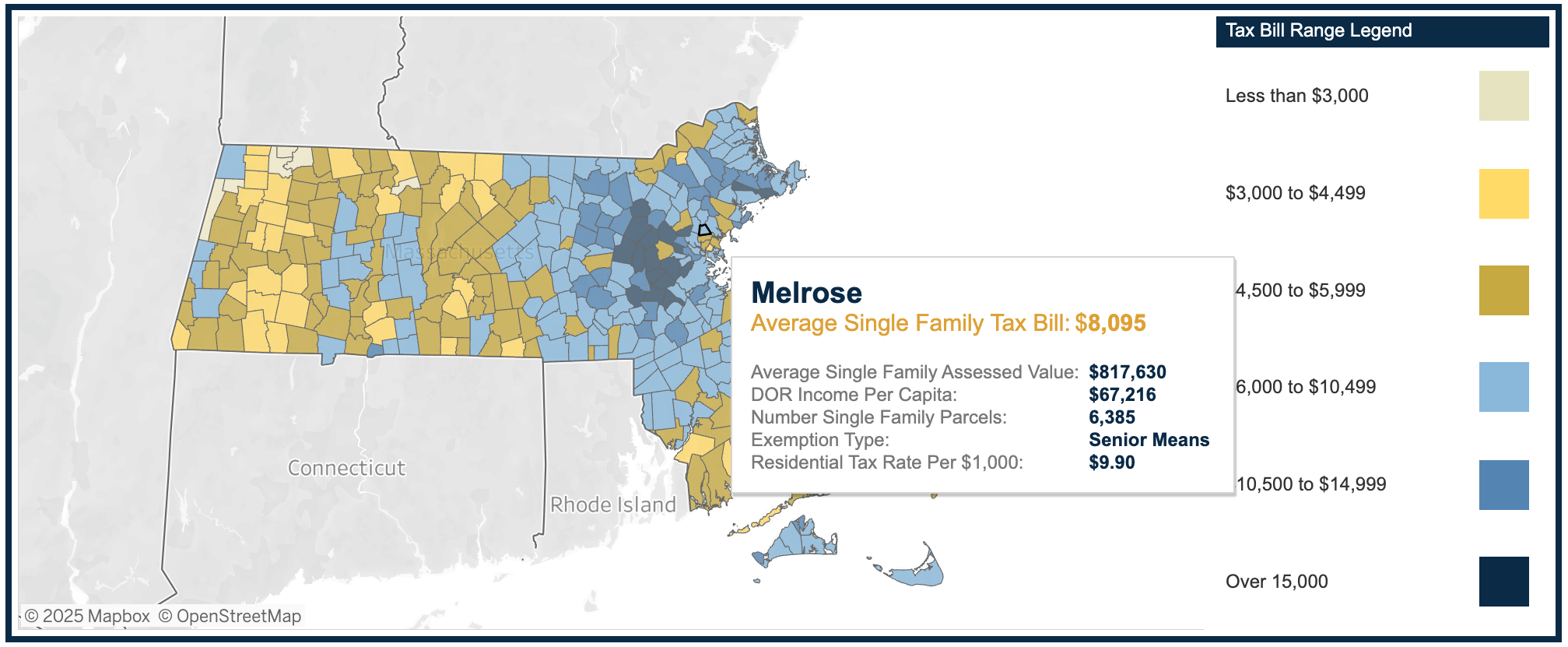
Average single-family tax bill in Melrose relative to other communities
Lipper-Garabedian and Lewis worked with their colleagues in the state legislature to increase the amount that minimum state aid communities received this year from a $30 per pupil increase to a $150 per pupil increase. This resulted in a total increase of $600,000 in Chapter 70 aid over last year - helpful, but not enough to close the $4.6 million deficit the Melrose Public Schools faced heading into this school year, in order to maintain the same level of services as last year.
The state does provide school districts with some additional support for rising costs. Lewis described, for instance, the state’s special education reimbursement program, or circuit breaker, which reimburses school districts for special education services above a certain threshold, and is most frequently used for students who receive out-of-district placements. The school district pays for each student up to a certain threshold - currently over $50,000 - and then the state will reimburse the school district for 75% of costs beyond that amount.
While the program can help ensure that no single student’s expenses will completely overwhelm a school district, it doesn’t kick in until the expenditures for a single student are significantly higher than the district’s per pupil average (which is currently a little over $18,000). And it’s worth nothing that the district doesn’t receive the reimbursement until the school year after the one in which the expenses were made.
Additionally, cities and towns pay tuition for students who attend schools outside their school district - for Melrose, most commonly either the Mystic Valley Regional Charter School in Malden or Northeast Metropolitan Regional Vocational School in Wakefield, enrollment for both of which has increased over the last several years.
While tuition for regional vocational schools is paid entirely by the sending district, Lewis noted that the state does reimburse cities and towns for charter tuition for the first three years a student attends a charter school - 100% for the first year, and lower percentages for the second and third years. “It’s meant to help in the transition period,” he said, “but it’s not a full solution.”
“I was shocked when I heard that Massachusetts reimburses cities and towns for charter tuition,” added Lipper-Garabedian. “We effectively double pay for students - I don’t think that any other state does that.”
Charter tuition reimbursement from the state has certainly helped Melrose make up some of the difference: charter tuition for Melrose has increased by almost 90% over the last ten years, while the net the city has paid has only increased by 50%. But if all of the students who are currently attending a charter school remain there, the tuition Melrose will be responsible for will continue to grow in coming years. And since families have the legal right to choose to attend a charter school, this is another budget item that Melrose has no control over, unless the city is able to encourage families to come back to the Melrose Public Schools - and that is unlikely to happen if class sizes in Melrose continue to grow and offerings continue to shrink.
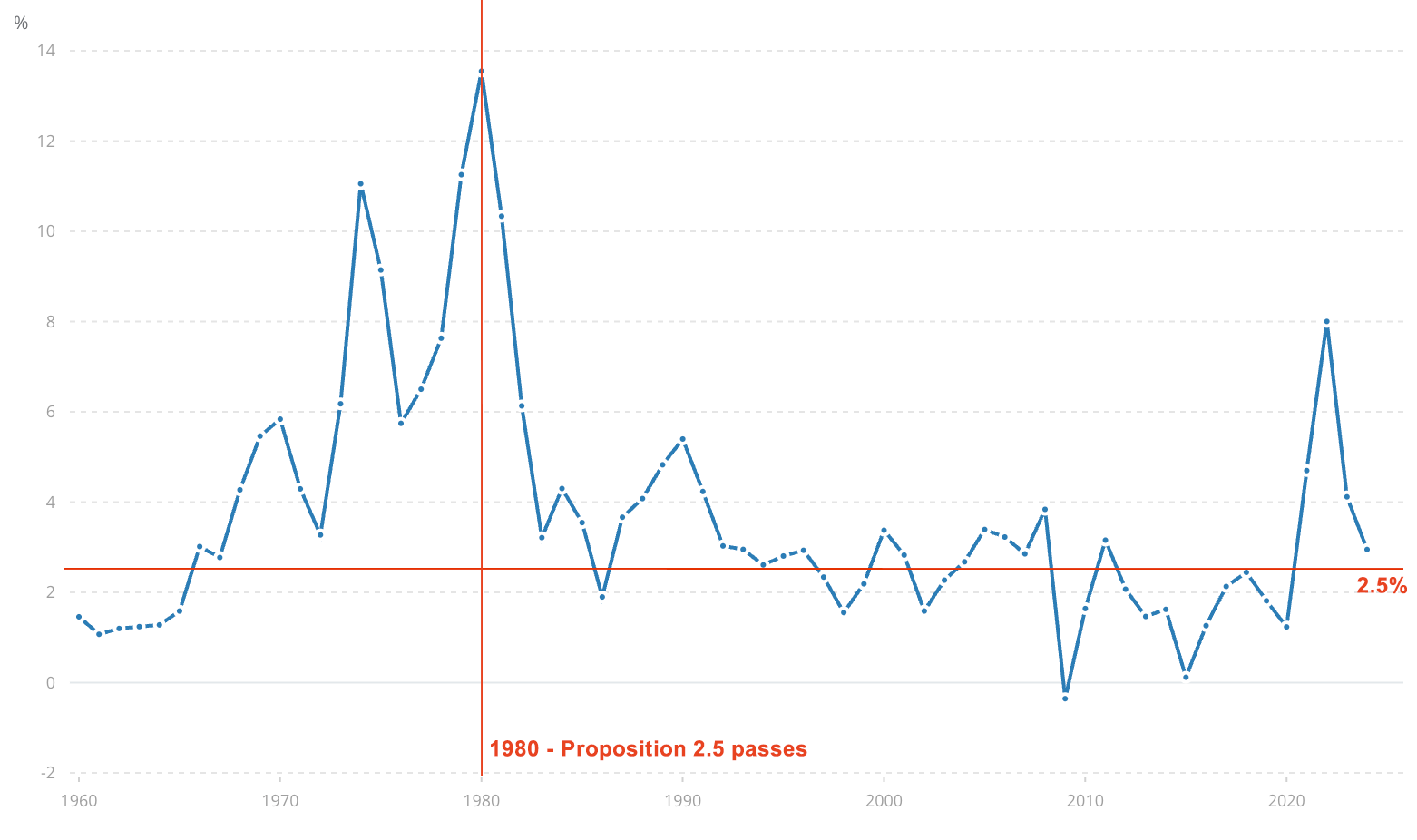
Inflation rates in the U.S., 1960-2024
“I represent six cities and towns,” said Lewis, “and all of them are facing significant fiscal challenges right now. It’s not a surprise - we’ve had Proposition 2½ since 1980. When inflation is low, most communities can find a way to make things work. We’ve enjoyed a pretty long period of low inflation, but that has not been the case in recent years - we’ve now had several years of much higher inflation. There is a lag period, but then municipalities really feel the pain because costs have gone up and revenues are constrained.”
(Proposition 2½, a 1980 statewide ballot measure, prohibits cities and towns from increasing the total amount they collect in property taxes each year by more than 2.5%, plus some amount calculated to reflect new growth, unless voters pass a property tax override for a specific amount to be added to the total property tax levy.)
“Your neighbors in Stoneham failed to pass their override,” he went on, “and I’m meeting with them next week to make plans for what’s next - they’re most likely going to put another override before their voters soon. We hear this everywhere: it’s a very challenging time for municipal budgets.”
Asked whether, with so many cities and towns facing the same financial challenges, there might be an appetite to make changes to Proposition 2½, Lipper-Garabedian noted, “there are two ways we could adjust Proposition 2½: the legislature could update it, or there could be another ballot initiative to change it.”
“There were over 6,000 bills filed during this legislative session,” she said, “and not a single one was about Proposition 2½. I think there are a number of reasons for that but, obviously, one is that folks in the legislature are loath to say that we’re going to raise taxes without voter input, because it was voters who went to the ballot box, back in the day, and said, ‘This is what we want as a Commonwealth-wide limit on property tax growth.’”
“I’ve done some research into this,” Lipper-Garabedian went on, “and Massachusetts is not unique in having some kind of statute on the books that creates some sort of levy limit or other type of growth limit on property taxes. Most states do have something in their state laws that largely came up during the same sort of anti-tax movement that resulted in Proposition 2½.”
“There are different ways in which states do it,” she explained, “We are one of the states that allows for a local option to override it. Not every state does that. Some states tie the property tax limits to inflation, which makes it more dynamic and responsive to what true costs are to provide services.”
“So perhaps, short of completely repealing the law,” she continued, “maybe there could be some appetite among our colleagues - and it’s something that I am exploring - to say, ‘Could we update the statutory framework to be more flexible and recognize macroeconomic realities?’”
“But,” she cautioned, “one colleague, who has worked in revenue for a long time, has said, ‘If we do that at the legislature, there will be a ballot initiative the next day to repeal what we have done.’”
“And the other option would be to have a groundswell of support among advocacy organizations to take on this argument,” Lipper-Garabedian suggested, “and I look at organized labor as a perfect example, where they’ve had tremendous success at the ballot box in recent memory for public education, for the fair share amendment.”
“So there are a couple of different ways in which we could think about modifying the statute,” she concluded, “But it will not happen anytime soon.”
Lewis added, “I think it’s fairly telling that the Massachusetts Municipal Association, which isn’t shy about advocating the legislature on behalf of cities and towns, doesn’t even have this on their list. In all the years I’ve been in the legislature, they’ve never brought this up.”
Lewis also noted that some desire to change Proposition 2½ could come from some municipalities in Western Massachusetts that have now hit their levy ceiling - a less well-known aspect of the statute that prevents cities and towns from raising property taxes beyond a certain point, even with an override vote.
“They have no room to even pass an override,” he said. “They’re just stuck. I’ve thought for some time that this would force a conversation at the state level, as the number of communities in that situation continues to grow.”
School Committee Member Matthew Hartman noted that Governor Maura Healey’s office is now listing all of the federal funding cuts that affect Massachusetts on one website. Currently, that total is approaching a billion dollars. (The state’s total budget was $60.9 billion this year, and Massachusetts received $22.9 billion in federal funding last year.)
Governor Healey is empowered to make midyear budget cuts, often called 9C cuts, if the state experiences a sudden drop in revenue, although Lewis noted that Chapter 70 education funding is not subject to 9C cuts. However, Melrose residents may be affected by federal funding cuts in a number of ways, including healthcare, school meals, SNAP benefits, and transportation, in addition to the potential impact of federal funding cuts to the city and state budgets. And, depending on how anticipated Medicaid cuts will affect the state budget next year, cities and towns across Massachusetts may see a reduction in state aid next year.
Hartman reflected, “We are fortunate here in Melrose to have the option to pass an override. We are one of the only states that has the option to bring a vote forward. We have a tax cap available to us, to be able to fund our own future here, when such dark storm clouds are facing us. And it’s not only the inflationary pressures, it’s those future pressures that we’re going to have to be aware of. It’s very clear that things are going to change for us, and already have.”
Mayor Jen Grigoraitis shared, “We often hear from the public: ‘What about the state?’ It’s helpful to hear about the limitations of the state to backfill millions of dollars for every municipality. There just isn’t enough to go around to fill all the holes that are being created.”
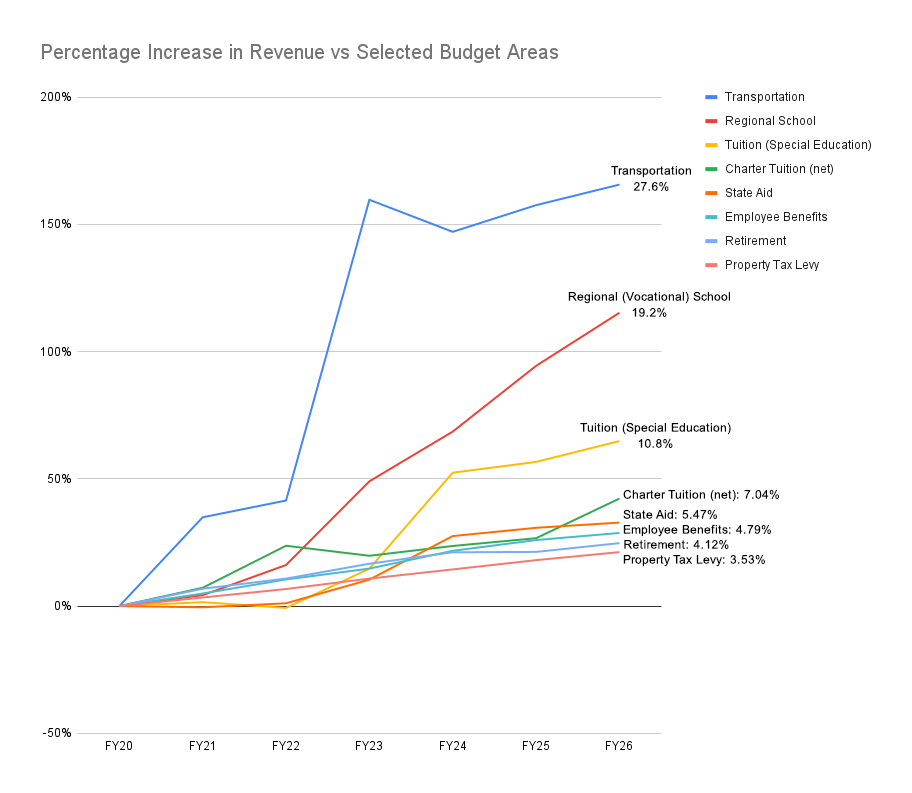
Percentage increases in selected budget areas vs revenue (average increase is labeled on each line), FY20-FY26.
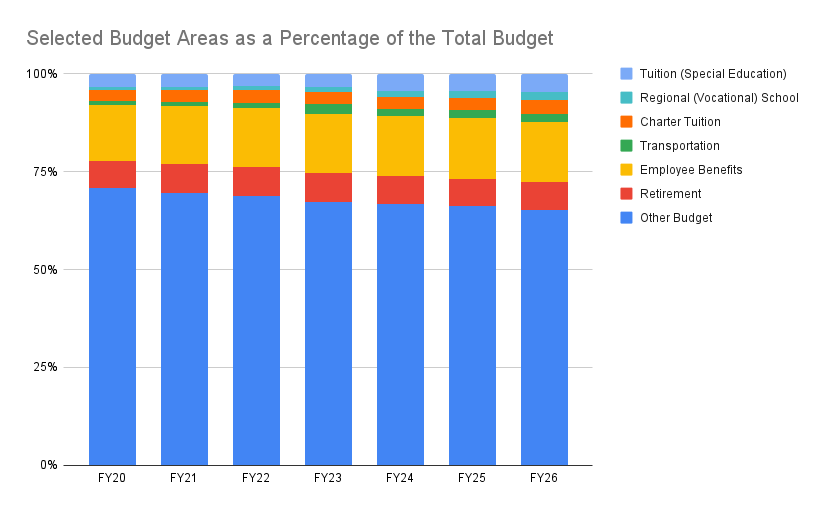
The selected budget areas from the figure above as a percentage of the total city budget.
Ward 5 City Councilor Kim Vandiver asked the state legislators whether there is anything the state can do to bring down some of the costs that are driving the budget gaps that many municipalities, including Melrose, are currently seeing.
“We’ve done a lot on the health insurance side to help manage costs,” Lewis said, noting that the Group Insurance Commission (GIC), which Melrose is part of, often offers lower rates than the private market . He noted that participation in the GIC did not seem to help much this year, when Melrose and other municipalities that participate in the GIC saw an increase of 12.9% in healthcare premiums.
“Special education is very difficult because so much is required under state and federal law,” Lewis went on, “and students are entitled to services - so it’s often a question of how best to provide these services. I do think Melrose and other school districts try to be smart about doing what they can in their own district or in a collaborative, which is a cost-effective way to do it. But some students need to be placed in special schools, and the reality is, those schools are very expensive. These are kids who often have very complex needs.”
In terms of the rising costs of school transportation (which, in Melrose, is required for students with disabilities or students with other specific needs, such as homeless students), Lewis said, "Unfortunately we have too few transportation vendors in state, so it’s not typically a very competitive process, and they’re able to extort what they want from school districts.”
“We had a special commission look at this a number of years ago,” he went on, “and we’ve been trying to figure out what we could do at the state level - there’s some legislation in the education committee on this right now - but there’s just no easy answers. It’s clearly a growing pain point for districts, and fundamentally, we need to find ways to increase supply of the services.”
“Transportation is one place where it feels like the economies are not quite right,” Lipper-Garabedian added, “and there may also be some local creativity and maybe some regional effort that could be undertaken at this level. But the cost to educate high-needs students - we have a real duty to make sure that we provide a quality experience for them, and that does cost quite a bit of money.”
Lewis noted that one of the challenges that Massachusetts, in particular, faces with funding its schools, is that schools in Massachusetts generally operate at the local level. In Maryland, which has similar demographics to Massachusetts and which Lewis gave as an example, schools are operated at the county level, which can provide some economies of scale.
“Is that a better model?” he asked. “There’s a lot to be said for local governance - families have more control. It’s a tradeoff.”
“Our state is consistently ranked number one in the nation for public education,” commented City Councilor At Large Ryan Williams, “and that’s a signal that the way we do it works, and the way they do it in other places doesn’t work as well.”
“These are great ideas and great questions,” commented McAndrew, “but none of this is going to solve anything for Melrose before the election on November 4th.”
“Melrose funds our government through a combination of state and local funds,” she went on, “and the state funds come in part from the federal government, which is currently being devastated. The most vulnerable people in Massachusetts will suffer - many children, including many children in Melrose.”
McAndrew noted that even with the significant cuts that Melrose saw in this year’s budget, “we aren’t even feeling the impact of the federal cuts here in Melrose yet. We are already starting from a pretty devastating budget for kids in Melrose, and now we’re facing even more cuts.”