‘Drag Nun’ Controversy at Unitarian Church Highlights Challenges and Potential for Religious Dialogue
By Ellen Putnam
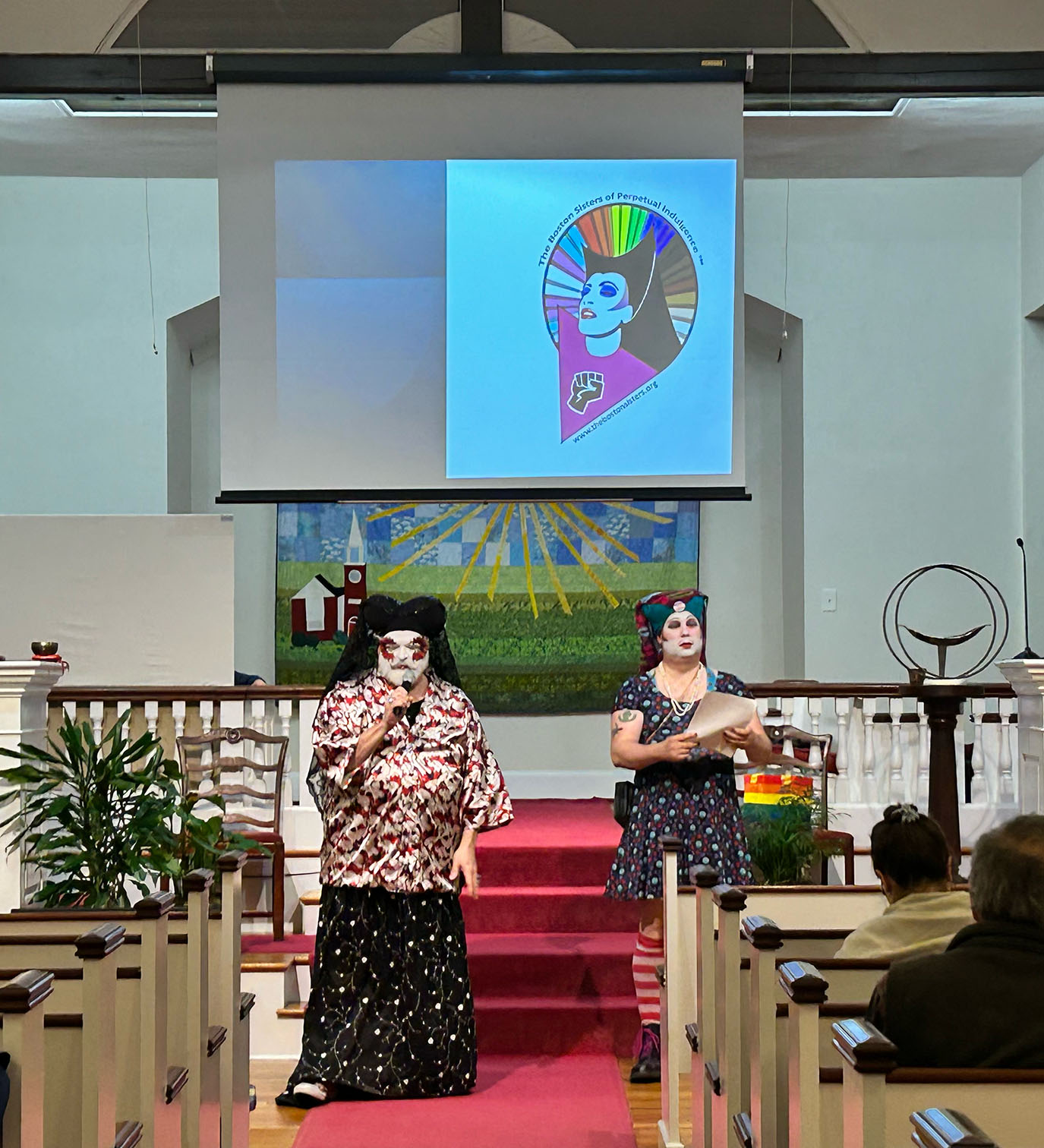
Sisters of Perpetual Indulgence at Melrose Unitarian Universalist Church
Photo from Melrose Unitarian Universalist Church
Earlier this month, the Melrose Unitarian Universalist Church (MUUC) drew criticism from some local Catholics when they hosted members of the Sisters of Perpetual Indulgence, a group of drag artists who wear nuns’ habits in their performances, for the church’s monthly Thoughtful Thursday program.
The Thoughtful Thursday program began last year, explained Rev. Dr. Susanne Intriligator, the minister at MUUC, “as a way for the church to engage the whole community in programs that are related to our values as a church - it’s a way to let the community know what we stand for.” Past programs have included local historian Jim Bennett talking about the history of race and redlining in Melrose; ‘Trans 101’ led by a local trans activist; and a forum on Melrose’s recent override questions.
The Sisters of Perpetual Indulgence, which this month’s guests belong to, were founded in 1976. They call themselves an “Order of queer and trans nuns” and they use drag, in which (usually male) performers cross-dress as female nuns with exaggerated clothing and makeup, in their performances and activities.
Rhea Brown-Bright, the church’s Director of Lifespan Religious Education, invited two members of the Sisters of Perpetual Indulgence to MUUC because, they explained, “I have known them to do incredible work in the community, and they have been deeply impactful.” The Sisters of Perpetual Indulgence have been involved in community service and social activism in many forms since the group was founded in 1976, including during the AIDS crisis in the 1980s and 90s.
“Their focus is on letting go of shame and on the uplifting of joy,” explained Brown-Bright, noting that shame and fear of embracing the true self can be particular challenges for queer and trans people. “As Unitarians,” they went on, “it’s deeply important to us to think of what a joyful world looks like, and to let go of the negative.”
There are religious sisters and nuns in a number of different religious traditions. However, most of the clothing and imagery used by the Sisters of Perpetual Indulgence appears to refer specifically to Catholic nuns and religious practices, which can be seen as mocking and disrespectful to Catholics in general, and specifically to Catholic sisters and nuns.
American Catholics are a large group - 20% of Americans and 29% of Massachusetts residents identify as Catholic - and they represent a huge range of backgrounds, opinions, and political persuasions. And opinions on the Sisters of Perpetual Indulgence don’t break down neatly along religious lines: a brief review of opinion pieces about the group in Catholic-focused publications reveals views that range from those who denounce the Sisters of Perpetual Indulgence as an anti-Catholic hate group to those who appreciate their community service.
Some of the writers who hold more ambivalent views include Sister Jeannine Gramick, who in this piece applauds the Sisters of Perpetual Indulgence for their good works while also expressing personal discomfort with their use of nuns’ garb. And in this piece, Michael J. O’Loughlin, the executive director of Outreach, an LGBTQ Catholic ministry, reflects, “For the sisters I know, it would take more than a man in a silly costume telling bawdy jokes to offend them. Still, I cannot quite shake the feeling that the Sisters of Perpetual Indulgence are, at least in some ways, punching down.”
“Faith is so deeply personal, and it comes in many different forms,” Brown-Bright acknowledged, “and there are going to be Catholics who feel harmed by it, and others who embrace it, and others who are in the middle. I can understand why some folks would feel hurt by it.”
There are fewer than 50,000 Catholic nuns and sisters in the United States today - down from a high of 180,000 in 1965 - and over three-quarters of their population is 70 or older. Different orders of Catholic sisters work in education, nursing, and social work, with many taking vows of poverty as part of their dedication to their work.
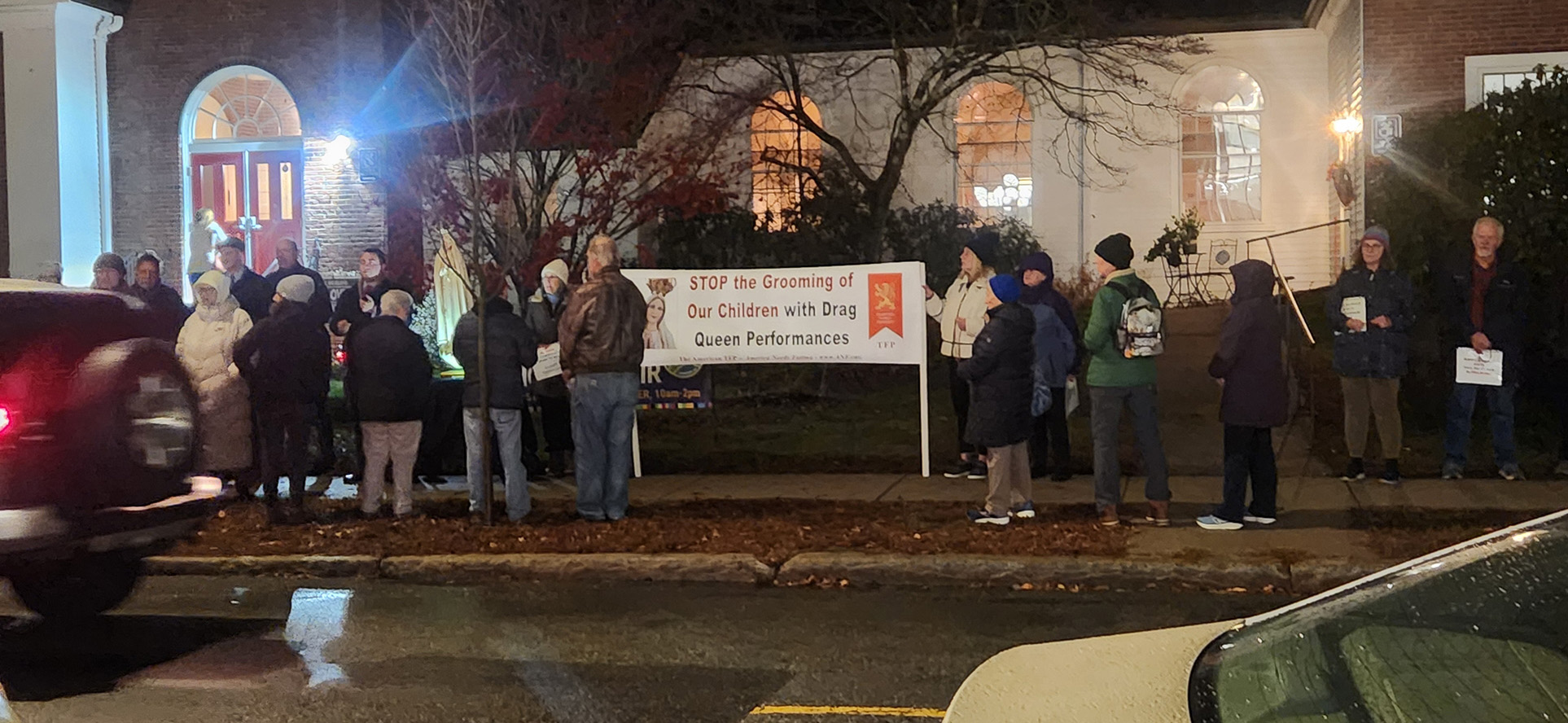
Rosary Rally in front of the Melrose Unitarian Universalist Church
Photo from Melrose Unitarian Universalist Church
When Melrose residents Dr. Gayle-Jean Angelo and Pat McDermott heard that MUUC was hosting an event with members of the Sisters of Perpetual Indulgence, they decided to organize a Rosary Rally. The Rosary Rally, where a group gathers to pray a Rosary together, involved what McDermott described as a Holy Rosary of Reparation (to make reparation for sins and offenses against God) in response to what they saw as a group that mocks their religious beliefs. The issue was especially personal for Angelo, who once took religious vows herself.
“Even their title - the Sisters of Perpetual Indulgence - offends me,” said Angelo, “because real nuns and real sisters do not indulge. They take a vow of chastity.”
In what sounds like an unfortunate case of crossed wires, McDermott stated that, prior to the event, one of the Rosary Rally participants called MUUC in an attempt to talk about the planned event, but never heard back from them; MUUC leadership stated that they never received the messages. Both groups expressed the desire to speak with one another and foster a robust dialogue. (We were able to connect them in the course of writing this article, and we hope that a productive conversation comes out of that connection!)
And while, in the past, the Melrose Interfaith Clergy Association has included Catholic clergy, it does not at present, which meant that avenue for dialogue was not available ahead of the event, either. Father Michael Rora, who became the pastor of Incarnation Parish just last year, stated that, while initial conversations with a few of the non-Catholic clergy in town have not yet resulted in ongoing collaboration, “I hope we can work toward greater interfaith cooperation in Melrose, because it has been lacking the past few years.”
Thirty Catholics from Melrose and surrounding communities ended up attending the Rosary Rally. Two of the participants were connected to the American Society for the Defense of Tradition, Family, and Property, which has organized protests against events involving the Sisters of Perpetual Indulgence in other places, although Angelo and McDermott stated that the event in front of MUUC was entirely local, and was not sponsored or supported by any kind of organized group.
Both Angelo and McDermott emphasized that, for them, organizing the Rosary Rally was not about anyone’s identity, but specifically against the use of drag performance to mock nuns and sisters. They both expressed support for friends, family, and neighbors who are LGBTQ.
“If they weren’t making fun of nuns, we would have no reason to protest,” Angelo explained. “If it were just a drag show, that would be fine.”
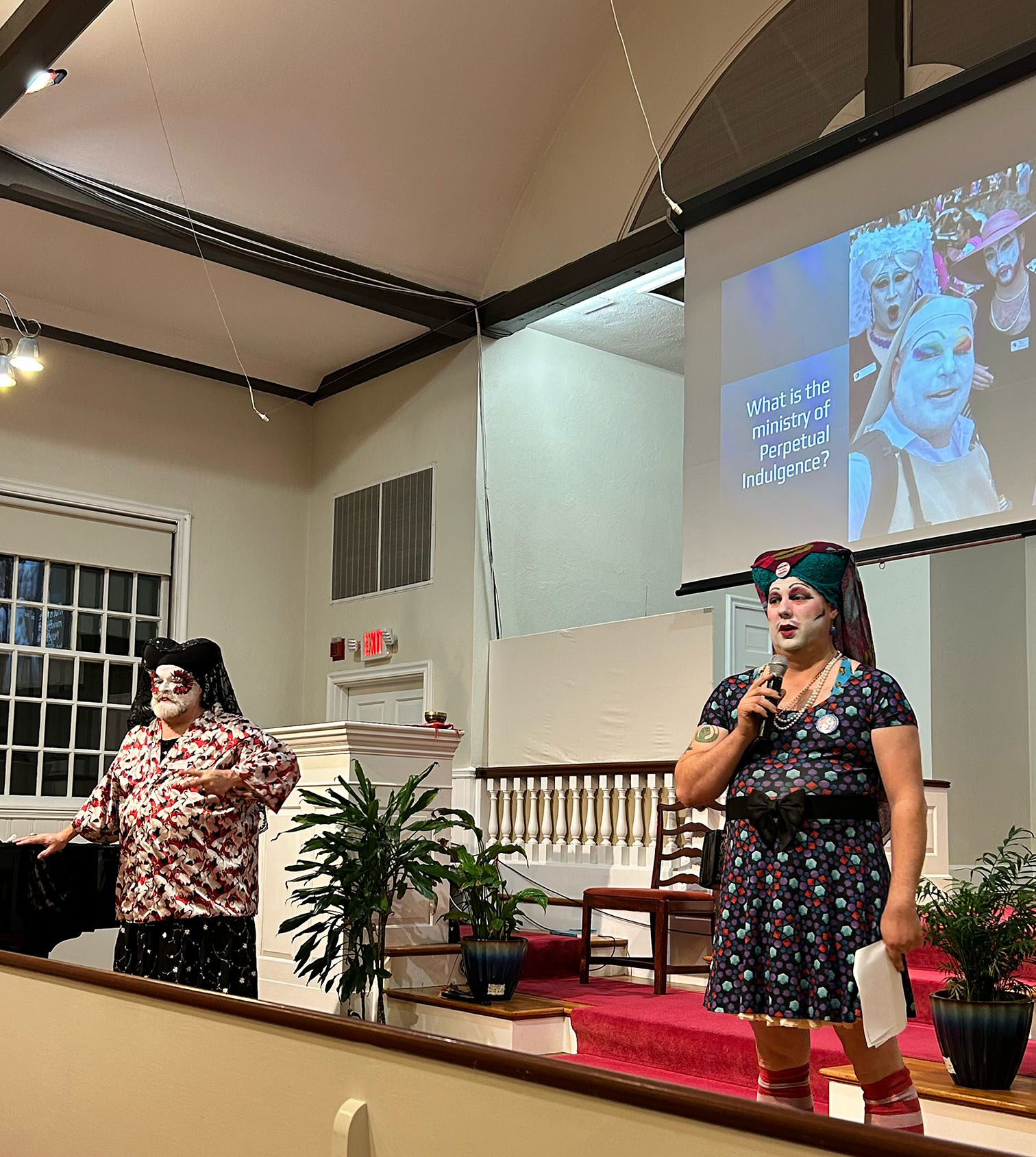
Sisters of Perpetual Indulgence at Melrose Unitarian Universalist Church
Photo from Melrose Unitarian Universalist Church
Some rally participants held a sign that read, “Stop the Grooming of Our Children with Drag Queen Performances,” which MUUC leadership found especially hurtful. “I believe that the grooming accusation is much more hateful,” she said. “They’re accusing us of a crime based on nothing.” (Intriligator and Brown-Bright both emphasized that there was no sexual content during the event, which was aimed at an adult audience.)
Behind the event and the response to it lie a number of long-standing hurts, including some that have taken place in our own community.
On the one hand, Brown-Bright argued that “drag and clowning is not mockery,” although they noted that many queer people “have a long and difficult relationship with religion and with Christianity,” and that the Sisters of Perpetual Indulgence was “born out of a time in the 1970s where that hurt was really alive - it came out of that particular emotion and feeling.”
On the other hand, our region - including Melrose itself - has a long history of discrimination toward Catholics. Not even a century ago - easily within the memory of many longtime Melrosians’ parents - Irish and Italian residents were often seen as second-class citizens.
“I see a tension between old Melrose and new,” reflected Intriligator. “Old Melrose feels very Catholic - new, not as much. And there’s not a lot of dialogue between those groups - we saw the tension between them during the override campaign. We need more intentional community-building and dialogue between those groups.”
Angelo suggested that a future Thoughtful Thursday could be dedicated to hearing from Catholic sisters about their work, or to an interfaith discussion.
She noted that she once collaborated with liberal Protestant minister Rev. Dr. William Sloane Coffin, Jr., and a Jewish colleague on stopping nuclear proliferation. “If we can get along, anybody can,” she reflected, “because we found common ground. We used to chide each other about things, but there was never hatred and anger.”
Intriligator and Brown-Bright, too, see the potential for finding common ground with their Catholic colleagues. “It would be really lovely to talk about the things we can do together,” Brown-Bright said. “There are lots of things that we deeply agree on, and areas that we have in common. There are also ways our theologies or practices don’t line up, but it would be meaningful to talk about those things together, and the work we can be doing in our community right now.”