School Committee Approves Berman as Superintendent, Supplemental Budget for Override Funds
By Ellen Putnam

Interim Superintendent Cari Berman, left, and School Committee Member Seamus Kelley
Screenshot from MMTV
On Tuesday evening, the School Committee voted to approve a supplemental budget for the funds from last month’s override vote. They also voted to appoint Interim Superintendent Cari Berman as permanent superintendent.
Although Melrose voters chose the highest override amount - $13.5 million - the text of the ballot question stated that this amount would only allow the schools to restore 17 of the more than 40 positions that were eliminated over the last two years.
Why are the override funds only restoring 17 positions in the schools?
Mayor Jen Grigoraitis stated when she introduced the override questions that she does not plan to bring back any positions that cannot be funded in full through the end of the next contract cycle, in Fiscal Year 2029, with the goal of not needing another override until then.
Personnel costs are the most expensive and fastest-growing part of the city’s budget, including contractual salary increases and rising costs of benefits. (Note that the School Committee is currently preparing to negotiate new contracts with the Melrose Educators Union - the city’s largest union - before the end of this school year, which are anticipated to significantly increase the city’s personnel costs.)
Grigoraitis has stated that the city would have needed to pass a $20 million override in order to restore all of the positions that were eliminated over the last two years and maintain them through FY29.
Much of the supplemental budget for the override funds for this year (FY26) is going to one-time expenses instead of personnel. This will include $4.3 million for school building maintenance and improvements, including a large project to renovate the bathrooms at Melrose High School. It also includes $525,000 for school technology needs.
The City Council voted last month to appropriate the funds for city departments, and now the School Committee has voted to divide the funds for the schools into categories, although Interim Superintendent Cari Berman has ultimate discretion as to how the funds should be used within those categories.
Last week, Berman presented a proposal to the School Committee that outlines the budget categories where she plans to restore positions, although precisely what positions and which schools they will go to is under her purview, not the School Committee’s.
How did we count changes in positions?
Positions in city government are usually measured in FTE (full-time equivalency). 1.0 FTE reflects an employee who is working full-time and is compensated for that. Fractions reflect employees who are either working part-time or who might be working part-time at two different schools.
Counting how many positions have changed in the schools from year to year is more challenging than it might appear, because not all positions are filled each year, and each year’s budget doesn’t always reflect what actually happens during the school year. We’ve measured changes in FTEs based on each year’s budget, but we’ve excluded paraprofessional positions, which are usually driven by the legally mandated needs of each school’s particular student population, independent of budget decisions.
Of the $3.8 million that is going directly to the Melrose Public Schools budget, more than half will be used for hiring 17 new staff and a pay increase for current staff that was negotiated earlier this year as part of a one-year contract extension with the Melrose Educators Union.
Berman’s proposal does not attempt to recreate exactly the positions that existed in the school district before the budget cuts of the last two years: she emphasized that the decisions on which positions should be restored arose from student learning data and observations about what is working this year, and what isn’t.
Berman proposed adding one teacher position back at the Franklin Early Childhood Center, and six teacher positions and one administrator position at the elementary level - although which schools those positions will go to is up to the superintendent. She suggested that the elementary administrator position could be an assistant principal: currently, some of the elementary schools have an administrator who serves as a part-time assistant principal and a part-time special education coordinator, and adding an additional position could rebalance their workload.
Melrose Veterans Memorial Middle School (MVMMS), where a net of 10 positions were eliminated between FY24 and FY26, is proposed to gain back 5 teachers, and Melrose High School (MHS), where a net of 15 positions were eliminated, is proposed to gain back 3 teachers.
The two schools would also share an additional administrator position, which Berman noted could be a curriculum coordinator. In the 2023-24 school year, Melrose had 12 curriculum directors and coordinators, all supervised by the Assistant Superintendent of Teaching and Learning; this year, there are only four directors left in that office, most of whom are fulfilling the district’s legal mandates, rather than coaching and evaluating teachers and organizing professional development.
At present, Berman is not proposing to add back a middle school principal position. While the decision this spring to make Jason Merrill the principal of the entire secondary campus was initially met with skepticism, educators, students, and parents all generally appear to be pleased with the current situation at the middle and high schools.
Speaking at this week's meeting, Berman noted that Merrill and Deputy Principal Bryan Corrigan are under contracts to serve as principal and deputy principal of the middle and high school through the end of this year, but that arrangement could be re-examined for next school year.
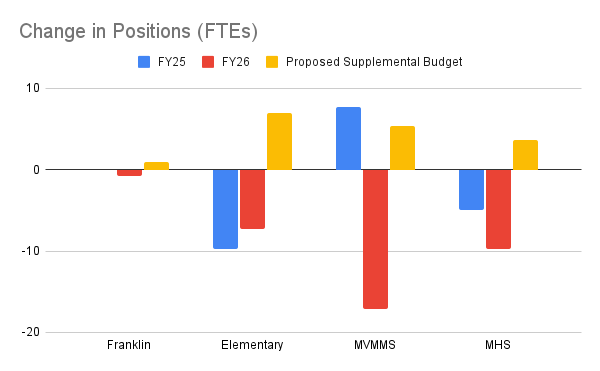
Positions eliminated and added back, last year and this year
“We have next year in our gazes,” Berman explained of her proposal. “This year and next year really have to dovetail together - they have to work together. We can’t hire positions for the second half of this year and then do something completely different for next year. Our focus is on hiring licensed and qualified staff; looking at our class sizes and seeing how we can reduce those; students’ socioemotional needs; and closing learning gaps within our subgroups. So how do we target instruction with the people that we have, that we can employ, to get that done?”
While Berman acknowledged that finding qualified educators halfway through the school year could be challenging, she noted that this could provide an opportunity to hire student teachers or promote paraprofessionals who have already been successful in the district.
She noted that she is currently looking at hiring classroom teachers for three of the elementary positions, to relieve some of the largest class sizes at the elementary level, and hiring literacy or math specialists in the other three roles, who could push into classrooms or lead small groups to help students who are struggling.
“It’s going to be a challenge to get licensed, highly qualified teachers in February,” Berman said, “but we’ll certainly try. We need to really think of what’s best for our youngest learners in terms of disruption - maybe we could bring on a new teacher and have them co-teach, get to know the students, and become their teacher next year.”
The restored positions are more heavily weighted toward the elementary level, relative to where positions have been cut over the last two years. School Committee Member Jennifer Razi-Thomas noted that teachers’ contracts state that the district must attempt to create class sizes that are less than 25 students whenever possible, while at the middle and high school many classes are at or above 30 students this year.
“Next year, we should hopefully be able to hire individuals and start with classrooms that are smaller from get-go with scheduling,” responded Berman. “The goal is to bring back the team model, definitely in the 6th grade as a starting point, and bringing on additional staff will help us to do that. It should also help to lower class sizes in the seventh and eighth grades.”
Commenting on the decision to have two of the 17 restored positions be administrators (one of which would likely be student-facing), Razi-Thomas noted, “I want to remind everyone that Melrose operates with very, very little administration. It’s an extremely lean district, if you compare it to any other district around.”
$1.5 million will go toward curriculum materials, including a multiyear contract for math curriculum that will help teachers address areas where students are struggling. And another $171,300 will go to instructional technology, including an upgrade for the Aspen software that the schools use to share information with families.
“We want engaged students,” reflected Berman, “we have incredible teachers, and now we want a powerful curriculum. We didn’t really have a mechanism within our instructional learning budget to invest in ongoing curriculums. With our core subjects, we want to be looking at and reviewing those instructional materials on a regular basis.”
The School Committee voted unanimously to approve the supplemental budget.
Then the School Committee returned to discussing whether to appoint Berman as permanent superintendent, or go through a search process.
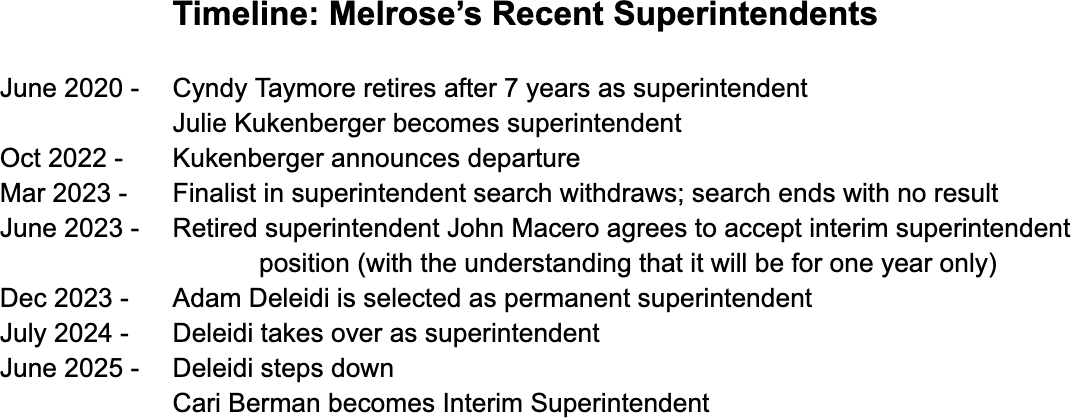
Berman is Melrose’s fifth superintendent in as many years. She previously served as the Assistant Superintendent for Pupil and Personnel Services, and took on the position of Interim Superintendent after Adam Deleidi suddenly left the superintendent position at the end of last school year, only one year into a three-year contract.
School Committee members reviewed a memo that laid out two possible paths for hiring a permanent superintendent: appointing the current interim superintendent to the permanent superintendent position pending contract negotiations, or conducting a search process for the next superintendent (in which Berman could be a candidate).
Last week, School Committee Member Margaret Driscoll reflected on her own experience on the School Committee, which has encompassed six superintendents and five superintendent searches. She observed that, while the memo suggested the process would take two to three months, “it always takes longer than you think.” She also noted that, while the search process would be anticipated to cost $15,000 to $20,000, there are a number of additional costs that aren’t included in that figure - everything from volunteers’ time to utility and janitorial costs for the space the screening committee uses.
“There is a significant financial investment,” she said, “and a significant human capital investment. And the landscape for superintendents in Massachusetts right now is very thin. We want to make sure that we have somebody with a good amount of experience, but it’s a tough job and it’s hard to hire, and, frankly, Melrose does not pay a huge amount. We are a small town. We are not able to pay $300,000 for a superintendent. And there’s no guarantee that somebody coming in would understand us or ultimately meld well.”
Looking at the other option - appointing Berman without a search - multiple School Committee members praised Berman for her skills as an educator and how she has performed so far this year as superintendent. They noted her loyalty to the district (she has taught and worked in Melrose for 25 years, working first as a special education teacher, a special education coordinator, and an assistant principal, before moving up to central administration) and her commitment to and passion for all students. (Berman's full resume can be found here.)
This commentary reflects feedback the School Committee gave Berman in her midyear evaluation, where they cited deep district knowledge, clear strategic vision, and strong collaboration as some of her strengths, noting her “ability to provide immediate stabilization and direction to the Melrose Public Schools, largely attributable to her extensive 20+ years of experience within the district.” The evaluation recommended that Berman continue to work on financial management and future budgeting, and monitoring instructional progress - areas that have been challenges for the Melrose Public Schools in recent years, due to budget struggles and leadership instability.
“What I am looking for in a superintendent,” said Razi-Thomas, “is someone who is passionate, who puts students first, who is trustworthy, who people feel they can trust, has an open-door policy, is approachable, has integrity, is loyal, can listen and take feedback and shift and pivot, has heart, has skill, is seasoned, is an excellent communicator, is a systems thinker, cares about diversity, equity, and inclusion, believes in all students, holds high standards and models high standards through their own behavior, and is passionate about the culture of every school. We’ve been extremely fortunate that Ms. Berman has stepped up to the plate and hit it out of the park.”

Joellen Beaudet, left, and Leslie Means
Screenshot from MMTV
During public comment last week, Leslie Means and Joellen Beaudet, president and vice president of the Melrose Educators Union, spoke in support of appointing Berman, and noted that an “overwhelming majority” of Melrose teachers agreed.
Merrill also spoke during public comment in support of Berman, noting that, in addition to his position as secondary principal, he is also a Melrose resident whose three children attend Melrose Public Schools.
“Ms. Berman has high expectations for all of our learners and loves all of our kids,” he said. “She has navigated us this year in the district through what was anticipated to probably be the most challenging months in recent history in this community. I think we lose sight of how challenging we thought it would be, because this has been one of the most rewarding falls for me, and I think things have gone well. But she’s been the steady leader that we’ve needed. She’s been able to still move the district forward while earning the respect of all of the teachers and administrators in the district.”
Interim Deputy Superintendent Ken Kelley also offered his support for Berman. “The override is a huge help,” he said, “but Melrose is still a lean operation, and that is something that Ms. Berman is completely at ease with. She functions well in it. She is relentless about high outcomes for kids. She has an extensive background in reducing barriers for students, and she’s very good at it.”
“We’ve sat through six months of interviews with Ms. Berman,” reflected School Committee Member Seamus Kelley, “and I haven’t heard one complaint from anybody in the public about her. Tonight, we had positive comments from the union as well as one of the administrators of our largest building, and both of them commented about loyalty. I think we’ve got big issues ahead of us in the coming year, and we have somebody here who wants to be the superintendent, and has demonstrated that she can be the superintendent. I don’t think we could possibly find somebody better, who on her first day on the job would know who to talk to, who the principals are, how to get the police chief on the phone if there’s an issue. I think that, if we were to move forward with Ms. Berman and she would accept, we’d be in a really good spot.”
Mayor Grigoraitis told Berman, “I am really grateful for your leadership and think that you are an incredibly strong candidate for this position,” but she also cautioned the School Committee against foregoing a search process.
“As the chief executive on the city side,” she explained, “I employ over 200 people, all of whom go through a hiring process for their job, whether it’s cleaning our high school or serving as a department head. I know there are two options before us, and I don’t love a binary choice. But I do want to consider: how do we have a more public conversation about what the future looks like? Because this is the highest-paid position in the district, it is one of the highest-paid positions within our city government, it has an enormous amount of responsibility, and I want to make sure that we are having a transparent and collaborative discussion about what we all see for the future of Melrose.”
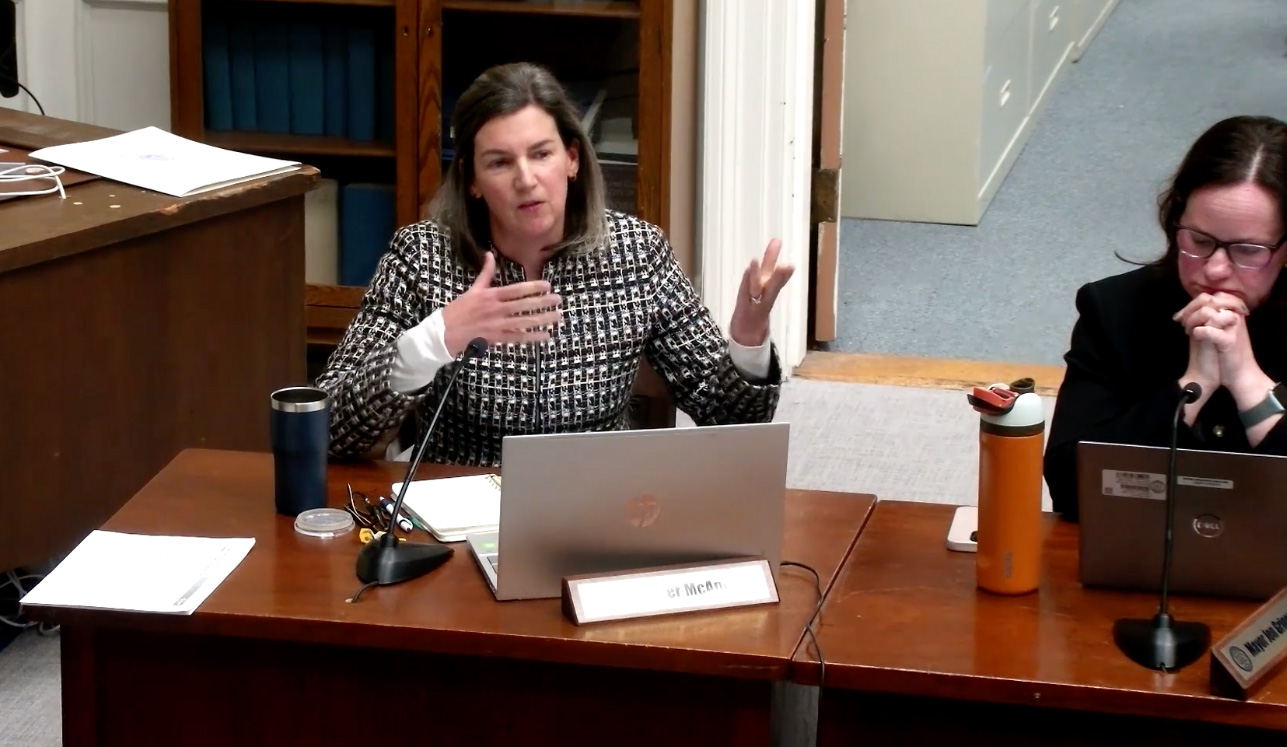
Jen McAndrew, left, and Mayor Jen Grigoraitis
Screenshot from MMTV
McAndrew commented on whether there might be some flexibility within the two proposed options, including the possibility of negotiating a two-year contract with Berman, rather than the typical three-year contract, or holding public listening sessions after appointing Berman.
“What I do not think we should do is some sort of truncated search,” she emphasized. “The superintendent search process in Massachusetts is pretty well established, and people who are at the level of applying to and considering superintendencies expect that process, and they have a right to expect that process. Maybe there are some tweaks we could do to speed it up, but anything that really differs from that, I think, would be considered unserious in the field.”
“Someone who really knows Melrose,” McAndrew went on, “is actually an incredibly unique qualification that we have in Ms. Berman. We have had a lot of change in the past decade in Melrose’s leadership across the board, and that can be great. One of the things that I’ve seen happen is that some of our more junior leaders in the district have grown into these leadership roles during that time. Probably eight years ago, they weren’t ready to be a superintendent or a deputy superintendent or the principal of a 6-12 campus, but now they are and they’re serving in those roles, and I think it’s actually a really terrific testament to the community, to Melrose and the Melrose Public Schools, that we have these leaders who are in these roles now.”
School Committee members asked Berman this week about her vision for the district and her approach to communication. Her cover letter to the School Committee identified financial stability, instructional focus, leadership development, and community engagement as Berman’s top priorities for the district.
Ultimately, the School Committee voted unanimously to appoint Berman as permanent superintendent.
“Tonight is my last regular meeting as a School Committee member,” reflected McAndrew, “and I have made some very tough decisions over the last eight years - but for me, this is not one of those. This is a very proud vote for me, and I believe this is a very proud vote for Melrose.”