Ranked Choice Voting Proponents Launch Campaign to Alter Municipal Voting In Melrose
Written By Ellen Putnam
Photographed By Nancy Clover
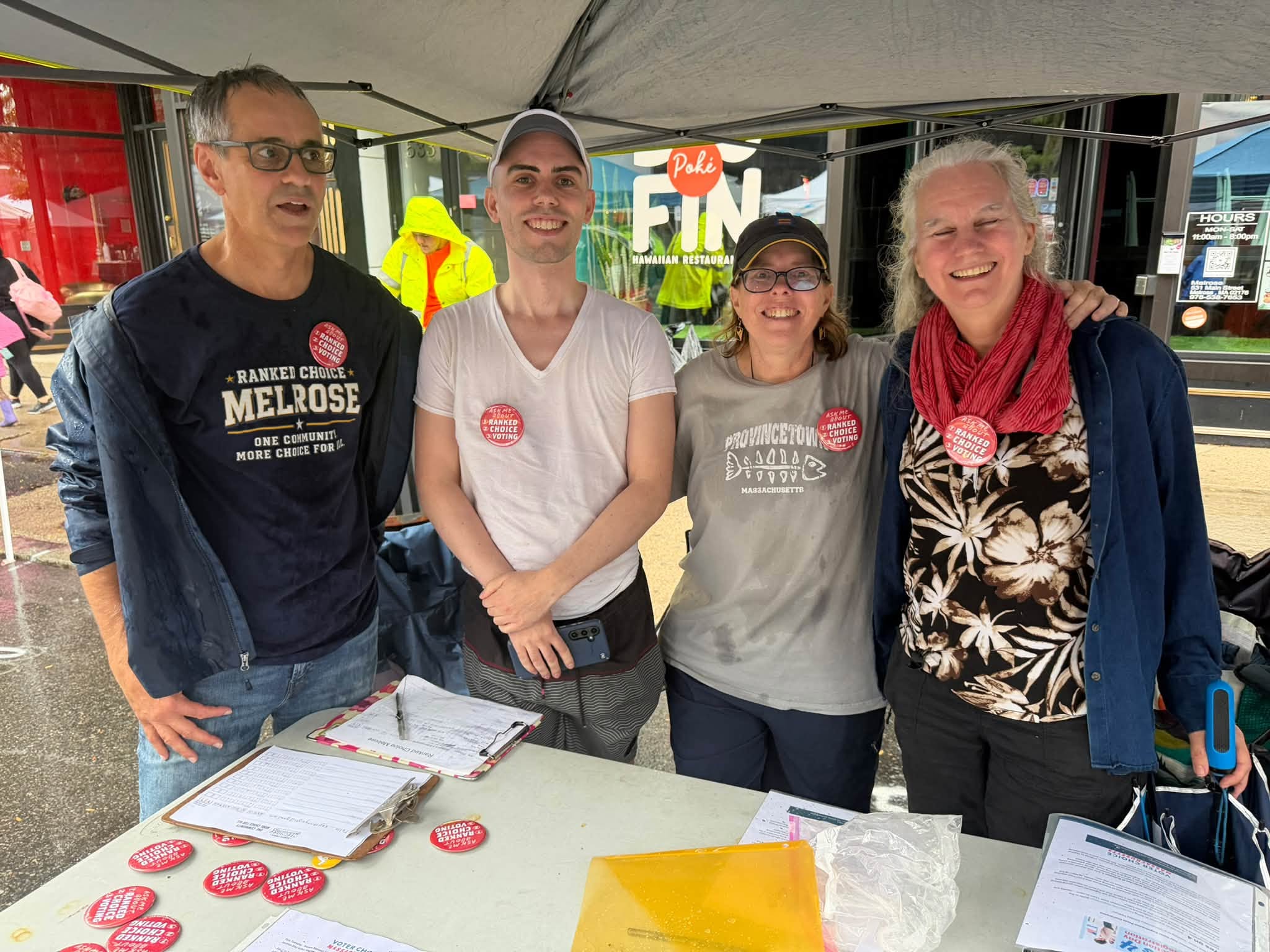
Ranked Choice Melrose supporters at this year's Victorian Fair
As the upcoming midterm elections generate discussion of voting systems and which voting methods best reflect voters’ preferences, a group of Melrose residents wants to bring ranked choice voting to Melrose’s municipal elections.
Ranked choice voting is a voting system by which voters can indicate their candidate choices in order of preference and, if their top-choice candidate does not get enough votes, their vote can transfer to their second-choice candidate, and so on. It is often promoted as a system that allows candidates to run without being afraid of a “spoiler effect” and allows voters to make choices without having to worry about their vote being “wasted” because it went to a losing candidate.
Two other states, Alaska and Maine, have ranked choice voting at the state level, although Alaska voters will be deciding this fall on a ballot question that would repeal ranked choice voting in their state. Cambridge has held ranked choice municipal elections since 1941, and Easthampton enacted ranked choice voting for municipal elections in 2019.
In 2020, Massachusetts voters rejected, 55% to 45%, a statewide ballot initiative that would have established ranked choice voting in state elections. (Melrose voters narrowly rejected the ballot question, 8507 to 8804.) After the ballot question failed, Secretary of State Bill Galvin, who had supported the measure, stated, “The idea behind it is a reasonable idea, but it’s complex, and many voters didn’t really grasp what it would mean for them.”
Now, Ranked Choice Melrose aims to introduce ranked choice voting to Melrose’s municipal elections.
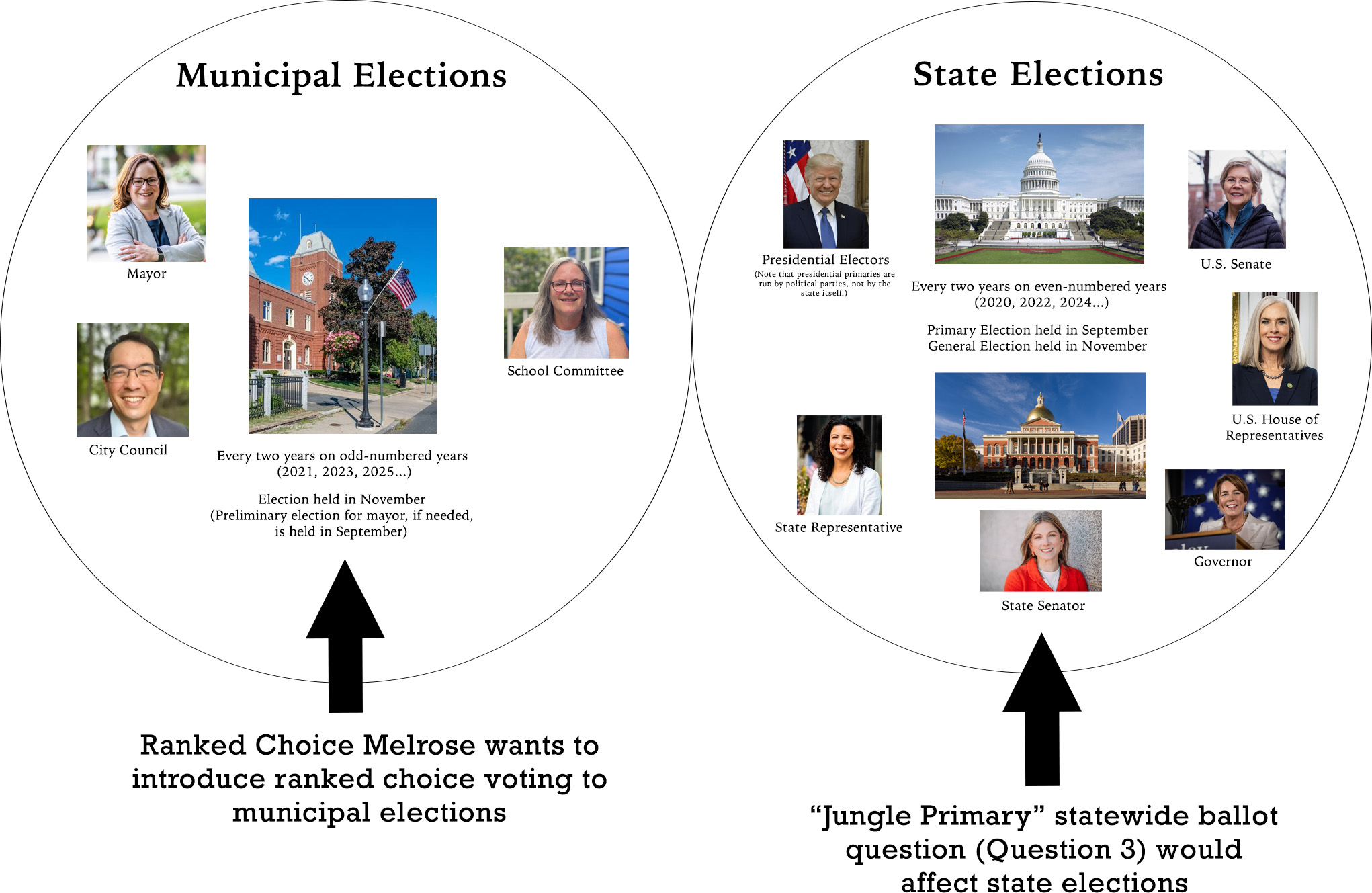
Ranked Choice Melrose aims to apply ranked choice voting only to municipal elections in Melrose. Ballot Question 3 would change only state primary elections.
Ranked choice voting should not be confused with this year's Ballot Question 3, the current statewide ballot initiative to replace partisan state primary elections with a single nonpartisan primary election. In this single “jungle primary,” the top two vote-getters, regardless of party affiliation, would appear on the ballot in the general election.
Supporters of the “jungle primary” ballot initiative argue that it could make general elections more competitive in Massachusetts, where Democrats are often the only candidates on the ballot and races are sometimes decided in the primary election (including in Melrose’s recent state representative and state senate races). It would also allow voters of all party affiliations to vote on all candidates at the primary level.
But the current system guarantees that for every race, if any choose to run, one Republican and all unenrolled candidates will appear on the ballot in November. Opponents of Question 3 argue that the measure could block Republicans and unenrolled candidates from making it to the ballot in the general election, if two Democrats win the primary election. Opponents also stated: “Similar top-two systems in California and Washington have favored wealthy, self-funded candidates who can out-advertise crowded fields and the corporate PACs seeking to purchase offices, while sidelining grassroots candidates.”

Dustin Cathcart, left, and Francis Blesso, co-founders of Ranked Choice Melrose at last week's launch event
Ranked Choice Melrose is a chapter of the state nonprofit organization Voter Choice Massachusetts, which led the 2020 ballot question campaign. Co-founders Francis Blesso and Dustin Cathcart met while advocating at the state level for ranked choice voting, discovered that they were both Melrose residents, and formed Ranked Choice Melrose in an effort to bring ranked choice voting to municipal elections in Melrose.
Voting in municipal elections can only be altered by making changes to the city’s charter. To do that, the City Council must make what is known as a home rule petition to the state legislature. The home rule petition must be approved by the state House of Representatives and state Senate and signed by the governor. Those changes must then be approved by a majority of Melrose voters.
The most recent changes to Melrose’s voting system were approved by voters in 2005. After Rob Dolan, who ended up serving as mayor for 16 years, won by only 10 votes in a five-way mayoral race in 2001, Melrose voters approved changes to the voting system that: established a preliminary election for mayoral races with three or more candidates; reduced the number of School Committee members from nine to seven (and added the mayor as one of those seven seats); and increased the terms of the mayor and School Committee members from two to four. Melrose voters approved those changes, 66% to 34%.
Blesso noted that the advantage of ranked choice voting over the current system is that in ranked choice voting, the majority of voters prefer the winner over the alternative, even if the winner wasn’t their first-choice vote.
Blesso and Cathcart identified several potential benefits to introducing ranked choice voting in Melrose, including encouraging more positive campaigns, encouraging more candidates to run, and ensuring that voters’ preferences are reflected in the election results. They also stated that introducing ranked choice voting would allow for the elimination of the mayoral preliminary election, which often has lower turnout than the municipal election in November.
Since the mayoral preliminary election was introduced in 2005, there have only been two instances where it was used: in 2019, when Paul Brodeur and Monica Medeiros earned 32% and 30% of the vote, respectively, against three other candidates; and in 2023, when Jen Grigoraitis received 36% of the vote, Medeiros Solano received 32%, and Sam Hammar received 31% and was eliminated from the race. The 2019 preliminary election saw 40% turnout compared to 51% turnout in the November election, and the 2023 preliminary election saw 26% turnout compared to 42% turnout in the November election.
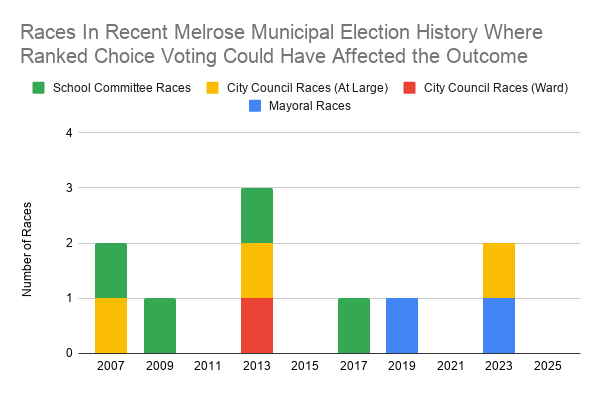
Since 2005, there have been a total of 10 races in Melrose where ranked choice voting could have affected the outcome (because at least one of the winners did not receive more than 50% of the vote).
Blesso and Cathcart argue that replacing the preliminary election for mayor with ranked choice voting would provide voters who would sit out the preliminary election with the opportunity to vote on all of the candidates, and would save the city approximately $30,000 in the cost of running the preliminary election.
Since 2005, there has only been one race for a ward seat for City Council where ranked choice voting could have had an effect on the outcome (because there were three or more candidates, and the winning candidate did not receive over 50% of the vote).
In that same time period, there have been three races for City Council At Large and four races for School Committee where ranked choice voting could have had an effect on the outcome.
The field for the 2023 race for City Council At Large was unusually crowded, with ten candidates for four seats, and the third through sixth place finishers were all within 300 votes of one another (out of a total of almost 9,000 votes), so it is possible that ranked choice voting could have generated a different outcome in that election.
(Note that, in all of these races, it is impossible to say, based on available information, whether the outcome would actually have been different with ranked choice voting, just whether ranked choice voting would have been relevant. And it’s worth noting that the presence of ranked choice voting can potentially change both candidate and voter behavior, so the hypothetical is not completely straightforward.)
It’s also worth noting that the more candidates there are in a race, the more confusing a ranked choice ballot can look (see these sample ballots from Cambridge’s most recent municipal election, where all nine City Council seats and all six School Committee seats are at large).
City Councilor Jason Chen attended the kickoff meeting for Ranked Choice Melrose last week, and expressed his support for the measure, noting that he believes that ranked choice voting can bring a wider range of political perspectives to the table.