Inside the Melrose High School Red Hawk Robotics Team
Written By Patrick DeVivo
Photographed By Nancy Clover
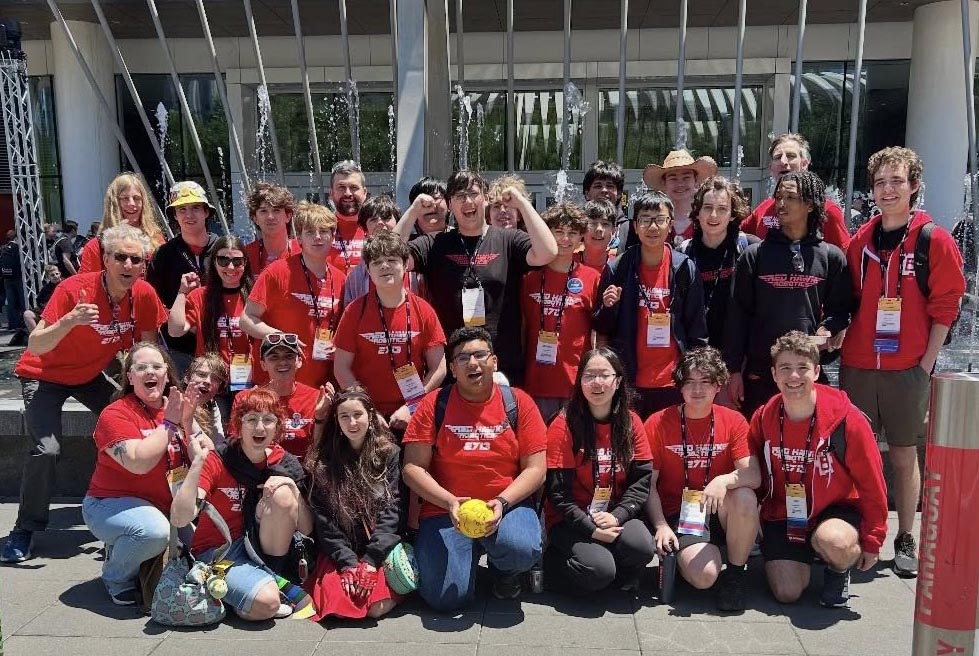
Red Hawk Robotics at the world championship this year
Photo From Red Hawk Robotics
This past spring, the Melrose High School Robotics Team concluded its most successful season yet. It ranked in the top 7% globally, placing 32nd in a field of over 600 teams from around the world in the Newton Division at the FIRST (For Inspiration and Recognition of Science and Technology) Robotics World Championship in Houston. The team also earned the Industrial Design Award and the SpaceX-sponsored Engineering Inspiration Award.
The Melrose High School Robotics Team was founded in 2008 by Melrose resident James Horne. What started out as a club of students sharing their common interest in robotics has steadily grown into an established team that competes with other robotics programs on behalf of Melrose High School, just like any varsity sports team. In fact, one of the program mentors pointed out that robotics competition may be the only sport where every participant can go pro, because the skills it teaches can translate directly into a career.
Although robots are becoming more important to our everyday lives, many more young people still learn to play a musical instrument, hit a baseball, or act in a play than learn to build a robot. To address this skill deficit, the Melrose Robotics program is set up as a three-level developmental pipeline built around standards established by FIRST, a nonprofit organization that runs youth robotics programs for more than 4 million students in 114 countries. In Melrose, that pipeline begins in elementary school and runs through senior year in high school.
FIRST kicks off each season with an overarching program theme. The theme for the 2026-2027 season is CANOPY: “Nothing on Earth thrives alone. Every gene, species, and ecosystem is part of a rich web of biological diversity that powers clean air, fresh water, and food.” Within that larger theme, each of the three levels of the program has its own specific theme.
FIRST LEGO League (FLL) is for elementary and early middle school students. This year’s theme is BIOGLOW, which focuses on exploring the world’s ecosystems. Parent volunteers organize this level, and small teams of four to ten students build simple robots from LEGO mechanical kits over a twelve-week fall season, from September to December. There are usually eight to twelve Melrose LEGO teams that compete locally and regionally. Melrose FLL teams also compete in the Red Hawk Rumble, a state qualifying event that Melrose students on the high school team help organize and run for the younger students. The Red Hawk Rumble attracts approximately 20 teams from Massachusetts and is viewed as one of the best FLL competitions in the state.

Last year's Lego League Red Hawk Rumble
FIRST Tech Challenge (FTC) is the middle-school level program where students start working with real nuts and bolts and 3D-printed or machined parts instead of snap-together pieces. This year’s theme is BIOBUZZ where students explore plants and pollination cycles. At this level, students design robots to compete in a two-on-two format, developing more strategic and collaborative match-time skills. This is the level where leadership and teamwork start to matter as much as technical skills. The FTC season runs from September to January.
FIRST Robotics Competition (FRC) is the high school team, or the “varsity” team, made up of roughly 30 to 50 students. By the time students reach the FRC level, they have been exposed to the technical skills of CAD design and basic mechanical assembly. The annual competition calls on the team to design and build a 135-pound competition robot under the rules of a new game released every January by FIRST. This year’s theme for the FRC level is BIOCORE, and it examines what sustains life on Earth.
This three-tiered pipeline is responsible for a significant increase in the number of students who arrive at the high school, or FRC, level already fluent in the basics of robotics: 60 to 70% of high schoolers on the FRC team have been through FLL or FTC levels.
Supporting this team is a group of approximately fifteen mentors: engineers, software developers, and other professionals who volunteer their time, sometimes several nights a week during the build season. Some are Melrose parents; others just enjoy working with the students and being part of the competition.
The high schoool robotics season runs nearly year-round. Preseason “skills training” in the fundamentals of CAD (Computer-Aided Design) and basic mechanical assembly begins over the summer. Fall brings scrimmage-style competitions where students use the previous year’s robot and game rules to get a feel for real competition.
On kickoff day, a 100-page rule book and a video explaining the current year’s challenge are simultaneously distributed to almost 4,000 participating programs around the world. Students at the FRC level have approximately two months to design, build, and refine a robot to present at the competition in the spring. Last year’s challenge called for the team to build a robot that launches balls into a hopper while navigating a series of obstacles that included a raised “bump” and a “low roofed trench.”
Once the season starts, the students’ commitment is similar to, or even exceeds, any varsity sport. The team meets four nights a week from 5:30 to 8:30 pm, plus a four- or five-hour Saturday session.

Last year's Nor'Easter competition at Melrose High School
The students who work on building a robot for the annual competitions are organized into several crews. Last year, crews were dedicated to robot engineering, chassis operation, ball intake, and elevator and shooter operation.
According to Ty Tremblay, a senior program mentor, students aren’t assigned roles so much as they self-select. “We don’t interview them; we encourage them to try out different crews to discover where their talents lie, and once a student has found their place, there is almost no holding them back.”
At the spring competitions, the work splits three ways: a drive team runs the robot in three-on-three competitive matches with other teams; a pit crew handles on-the-spot repairs and fields questions from roaming judges; and a scouting team tracks the performance of every other robot in the competition, feeding a statistical database. The database can have over 300 rows of performance data, which the team uses to pick alliance partners for elimination rounds. Recording performance statistics on every robot in the competition is analogous to the way a baseball team might track opponent batting and fielding averages so the crews operating the robot can make real-time strategy calls.
While some team members prepare and maintain the robot, an awards crew makes a formal presentation to a committee of judges, defending the team’s design choices and explaining how the team organized itself. Judges hand out awards for categories such as robot design, team spirit, and quality of engineering documentation. “Having the right talk track for the judges is not accidental,” says Gabby DeYoe, lead mentor for strategy. “We understand the awards we are targeting and know our differentiators. We then rehearse before the competition and work as a team to refine our answers so we present a united, collaborative front.”
“Students who put in the work,” says Tremblay, “are the ones who travel to the marquee events, including last spring’s trip to Houston.” When asked what she likes best about the program, Naomi Chambers, a team member, didn’t hesitate: “I like the challenge of working with my team to actually create a robot that can compete with other robots around the world,” she said, adding that she’s now considering majoring in engineering in college.
According to FIRST, 83% of its alumni go on to pursue STEM (Science, Technology, Engineering, Mathematics) majors in college. Red Hawks Robotics team members also acquire experience that benefits them no matter what career path they choose to pursue. The robotics program is explicitly designed to build confidence and workforce-ready skills, alongside technical ones.
“It’s really a full startup business,” says Dan Cerys, a long-time Mentor. “We need an office, we need tools, we need money, we need relationships with sponsors; everything a real company needs.”

Last year's Nor'Easter competition at Melrose High School
Opportunities exist for students beyond the building and operation of the robot. Almost all students at one time or another contribute to one of several support teams: a marketing and branding group that designs the team’s logo and merchandise and runs its social media; a finance team that manages an annual budget running well into six figures; and an outreach team that coordinates fundraising and sponsorships to cover costs such as travel, machine parts, entry fees, etc., and develops and delivers slide deck presentations to prospective sponsors.
DeYoe calls the program “a crash course in project management, public speaking, and leadership that most high schoolers never get elsewhere. They learn how an organization actually runs years before most of their peers will encounter that in their first job.”
Mentors also encourage students to build a professional network before graduation, including building a LinkedIn presence while they’re still in high school, so they arrive at college with connections already in place. “We do both formal and fun headshots to help students learn how to develop a professional presence that supports college applications, interviews, summer internships, and their careers,” says Chris Rancourt, Mentor for Media and PR.
The variety of roles is the reason why the robotics program is increasingly attractive to a wide range of students. “A student with no long-term interest in CAD design or wiring can still find a central role in finance, media, or fundraising,” says faculty advisor Elizabeth Giovanardi. “The team has historically included some of the school’s top-ranked students right alongside neurodiverse students who’ve found, on this team, a social home they hadn’t found elsewhere in the building.” The FIRST tagline is “More Than Robots.”
Achraf Boukirou, a Melrose High senior who joined the team this year, says he spends almost no time on the robot itself. “I primarily work on areas like the marketing and finances of the team.” Co-captain Constance Yang notes, “The program is expensive, and we do need a lot of help wherever we can get it with money.” She plans to study engineering in college and feels “very included and very proud to be on the team,” in part because the program makes room for students whose contributions may not be limited to building a robot. “That range of roles is part of what keeps the team from becoming a small, self-selecting club,” says Giovanardi. “It’s something everybody can do.”
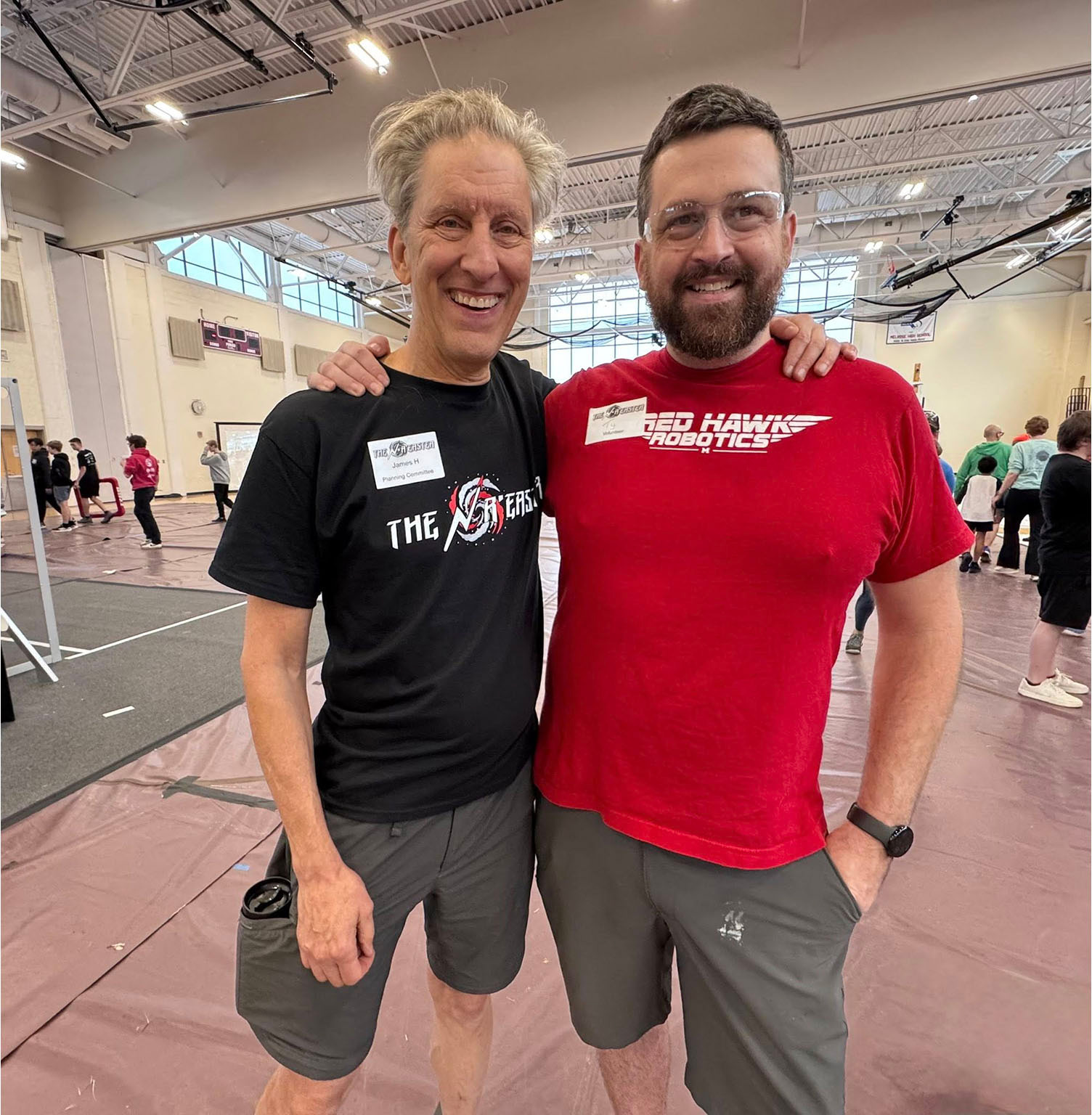
Horne, left, and Tremblay
Horne is an engineer who spent the early part of his career building industrial welding robots for the automotive industry. In 2008, he attended a Boston trade conference called the Front End of Innovation, where he learned about a competition built around exactly the things he loves: engineering, teamwork, and problem-solving under pressure.
“This is a program that combines sports competition plus a super cool skill of learning in an area that I love working in,” Horne said, recalling the moment he decided to bring FIRST Robotics to Melrose.
During the first few years, the team competed but never contended. The turning point came in 2021, when Tremblay moved to Melrose and began working with Red Hawk Robotics. Tremblay had grown up in the FIRST program in Alton, New Hampshire, and later coached a Worcester Polytechnic Institute-affiliated team before returning to Alton and coaching that team to several championships. His vision is to help build a powerhouse robotics program at Melrose High, so the school and the city are synonymous with elite world championship caliber robotics. Tremblay, now a software engineering manager at a Boston robotics startup, has spent two decades mentoring FIRST teams and says the culture is deliberately collaborative rather than cutthroat; teams that compete against each other in one match are often paired as allies in the next.
Unlike a school sports team, the robotics team receives essentially no direct funding from Melrose Public Schools. The district provides space in the old automotive shop at the high school, which has been designed for the school’s engineering and technology classes. However, this space is in dire need of updating and improvements. The roughly $80,000 to $100,000 it costs to run the program each year comes almost entirely from sponsorships and the team’s own fundraising.
Tremblay says the team’s main challenge going forward is less about talent than capacity, meaning more space, more funding, and continued interest from the school. “They see the value of the program,” he said of the district’s administration. “We are working with the administration to build a vision that provides support and helps to retain students in Melrose due to the excellent STEM education they will receive.” Melrose is one of the top 5 cities offering a robotics program in Massachusetts.
Giovanardi says student membership in the Red Hawk Robotics Program has roughly doubled over the past five years, evidence that a wider audience is aware of the opportunities offered by participation in the program.
The group of mentors has grown as well, including several who relocated from Texas after working at FIRST headquarters. “That expertise shows up in results, but the underlying mission hasn’t changed: get more Melrose students, regardless of their technical background, into a program that teaches them how to work with other people toward a shared, difficult goal. Skills they will need throughout the rest of their professional lives.”
According to Tremblay, “The better we do, the more support there is, and the more support there is, the better we do.” Corporate sponsors are now visible on the backs of team T-shirts, and the team is working this year to apply for grants earlier in the season rather than scrambling for funding once the build season is already underway.
Clover Melville joined the program as a seventh grader on Melrose’s small middle-school team that made it to the world championships. She went on to become team captain in high school and is now a Mechanical Engineer at Zoll Medical in Chelmsford. Melville still lists the robotics program on her resume, all these years later, because interviewers keep asking about it.
“Even though I have been off the team since 2017, I can still talk about that kind of stuff in my job interviews today,” she said. She credits the program for what it taught her about communication, problem-solving, and working with other people. “It’s what students learn through building a robot: how to manage a project, lead a team, speak to strangers, raise money, and recover when something breaks, that are of lasting value.”
A graduate of the Red Hawks Robotics Program walks away not only with marketable robotic design skills, but also with a network of people already headed into engineering, a hands-on education in skills like teamwork, leadership, communication, and resilience, and a resume line that gets them a follow-up question in every interview for any position no matter what they end up building.
Melrose residents interested in learning more about the Red Hawk Robotics should email contact@redhawkrobotics.org or fill out the interest form.