Melrose Residents See Override Impacts in Property Tax Bills
By Ellen Putnam
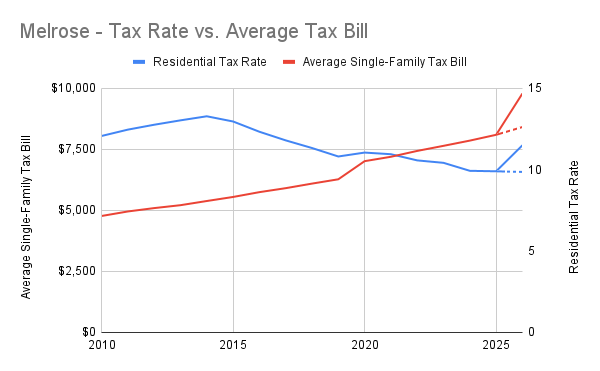
Tax rate vs. average tax bill for Melrose residents, 2010 to present
(The dotted lines represent the tax rate and average tax bill in FY26, if no override had passed.)
Last month, Melrose residents saw the first impacts of the $13.5 million override voters approved in November on their property tax bills for Quarter 3 and Quarter 4 of Fiscal Year 2026 (FY26).
The override passed in November - nearly halfway through FY26 - but it was retroactive to July 1st, 2025 (the beginning of FY26), which meant that the entire increase for FY26 was added to Quarter 3 and Quarter 4 tax bills. This left some residents surprised by how much they owe for the second half of FY26.
Specifically: for a home with the average assessed value (which is usually lower than market value) for Melrose of $853,264, the override resulted in an increase of $1,374 per year, relative to what its property tax bill would have been, had no override passed. (This matches what was projected on the Yes! For Melrose campaign’s override calculator for the highest override amount.) Those property owners would have seen an increase of $687 between their tax bills for Quarter 2 and Quarter 3 - but they will actually see a decrease between the bills for Quarter 4 of FY26 and Quarter 1 of FY27, when the increase from the override will be spread through all four quarters of the year, instead of just two.
(There are some property tax relief options available for seniors, veterans, and disabled residents. Any Melrose resident who is concerned about affording their property taxes should contact the office of the City Treasurer/Collector by email at treasurer@cityofmelrose.org or by phone at 781-979-4120 to discuss what options could be available to them.)
Melrose residents are also beginning to see the effects of the override funds on city services. Last month, the City Council passed a supplemental budget for the override funds, and the School Committee allocated the funds designated for the schools.
Over 60% of the supplemental budget will go to capital expenditures and investment in the city’s pension and post-employment benefits funds. 25% will go to contractual salary increases for school employees and salaries and benefits for 24 positions that will be restored in the schools, Department of Public Works, and police department. (The proportion of override funds the city will spend on salaries is expected to grow significantly as the city renegotiates contracts with its twelve employee unions this year and next.)
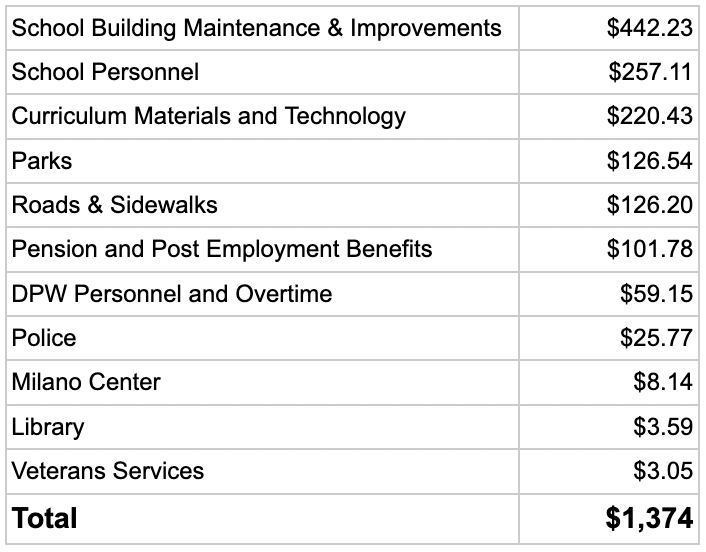
Breakdown of how the average property tax increase of $1,374 is divided among different supplemental budget items
Hiring has begun for the 24 positions restored by the override funds - 2 police officers, 5 Department of Public Works (DPW) employees, and 17 school employees - although hiring and onboarding new employees can take some time, and it may be challenging to find qualified educators halfway through the school year.
Most of the capital improvement projects - roads and sidewalks, parks, and work on the schools - will begin in the spring and summer.
The Melrose Public Library announced today that it will be open on Sundays again, starting on January 25th, from 2pm to 5pm. The library will also add more programming, supported by the override funds.
The increased overtime budget for the DPW can be seen in additional hours at the City Yard and items such as holiday lights and street cleaning.
One of the most talked-about changes made in FY26, prior to the passage of the override, was the removal of trash barrels from several parks, including the Melrose Common and Bowden Park, where the Melrose Farmers' Market takes place. While the removal of trash barrels was presented as a pilot program without an explicit budgetary component, it was driven in part by a reduction in DPW overtime hours that eliminated Sunday trash pickup at city parks.
The DPW's final decisions around where trash barrels will or will not be restored will not be made until spring: trash barrels from parks around the city are often removed during the winter to use for salt storage or to protect them from winter weather.