State Senator Jason Lewis Will Not Seek Re-Election
By Ellen Putnam
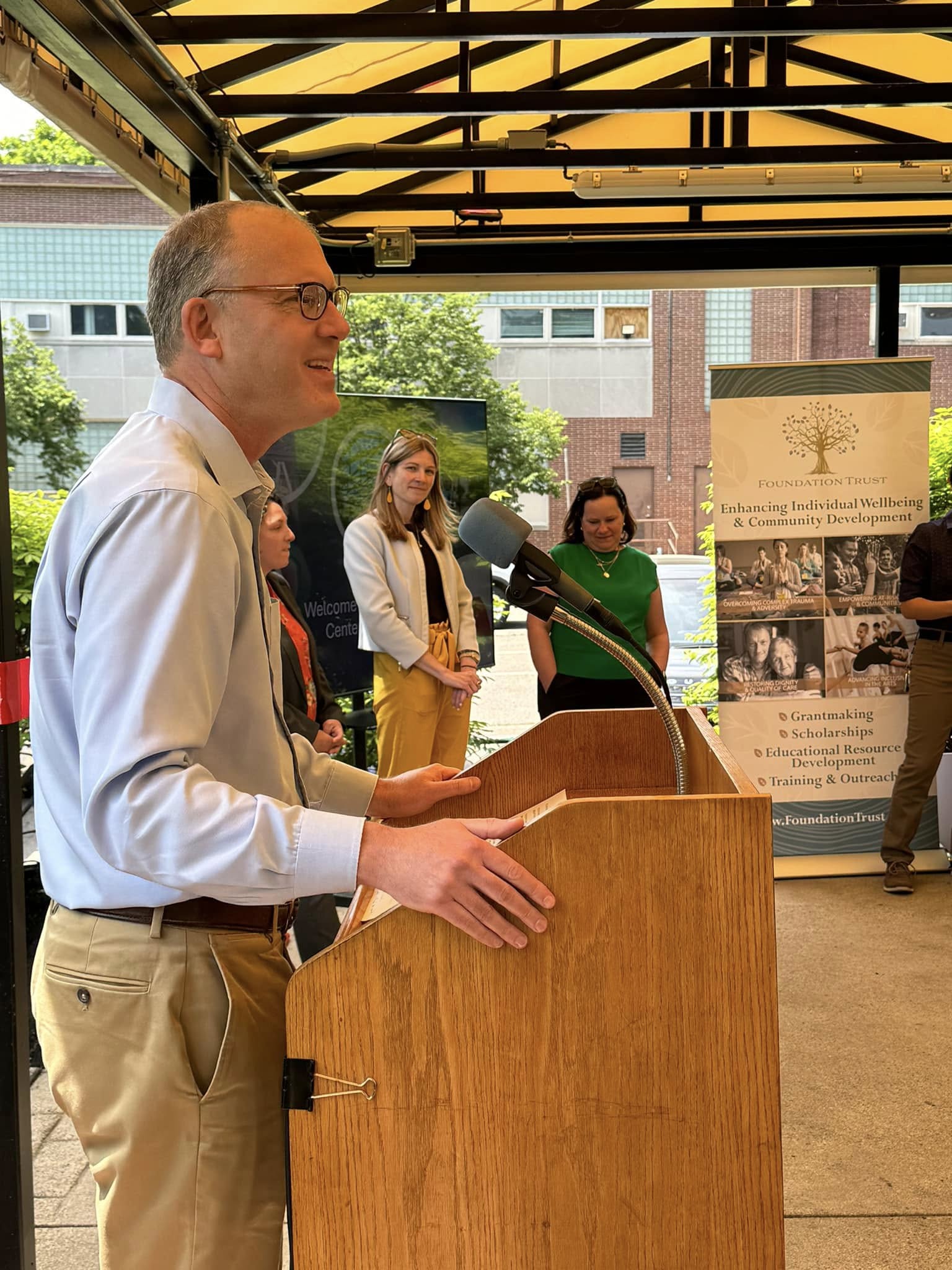
Jason Lewis speaking at an event at the Milano Center
Photo Credit: Nancy Clover
State Senator Jason Lewis announced today that he will not run for re-election this fall, opening up a seat that he has held for the last twelve years.
Lewis was first elected to the Massachusetts State House in 2008 as the state representative for the district that includes Stoneham and Winchester. He then ran for and was elected to the state Senate in a special election in 2014, after Katherine Clark was elected to Congress and left the Fifth Middlesex District seat open.
“After almost 12 years of proudly representing the Fifth Middlesex District, I have made the difficult decision not to run for re-election to the state Senate this year,” Lewis said in a statement. “Serving in the Senate and previously in the House of Representatives has been a great privilege. I am truly grateful to the voters who placed their faith in me in numerous elections.”
“I have had the opportunity to work on impactful legislation — like universal paid family and medical leave, increasing the minimum wage, the Student Opportunity Act, the Fair Share Amendment, strengthening early education and childcare, and Alzheimer's treatment — that has improved the lives of my constituents and residents across the Commonwealth. I have also been able to partner with community groups to pursue exciting local projects, including constructing the Tri-Community Greenway, opening the Bridge Recovery Center, renovating the Winchester Center Commuter Rail Station, building many new schools, and more. It has also been very rewarding to provide constituent services that have helped people access healthcare, unemployment insurance, housing assistance, and resolve other issues that they are struggling with.”
“I look forward to continuing to serve my constituents until the last day of this legislative term. After that I will begin a new chapter in my life, one in which I will find new ways to make a meaningful impact.”
Like its federal counterpart, Massachusetts has a bicameral state legislature (officially known as the General Court of the Commonwealth of Massachusetts), with two bodies: the House of Representatives and the Senate. All legislation, including the annual state budget, must pass both bodies and be signed into law by the Governor. 34 of the 40 seats in the state Senate are held by Democrats, and 134 of the 160 seats in the state House of Representatives are held by Democrats.
State Senator is one of the offices that will be on the ballot in the state election this fall, along with State Representative. The other offices that will be on the ballot include:
- U.S. Senator (currently held by Ed Markey, who is expected to have a number of challengers, including current U.S. Representative Seth Moulton);
- U.S. Representative (currently held by Katherine Clark, who is also expected to have challengers in both the primary and general elections);
- Governor (currently Maura Healey), Lieutenant Governor (currently Kim Driscoll), Attorney General (currently Andrea Campbell), Secretary of State (currently Bill Galvin), Treasurer (currently Deb Goldberg), and Auditor (currently Diana DiZoglio).
- Voters will also elect a Governor’s Councillor, District Attorney, and Register of Probate.
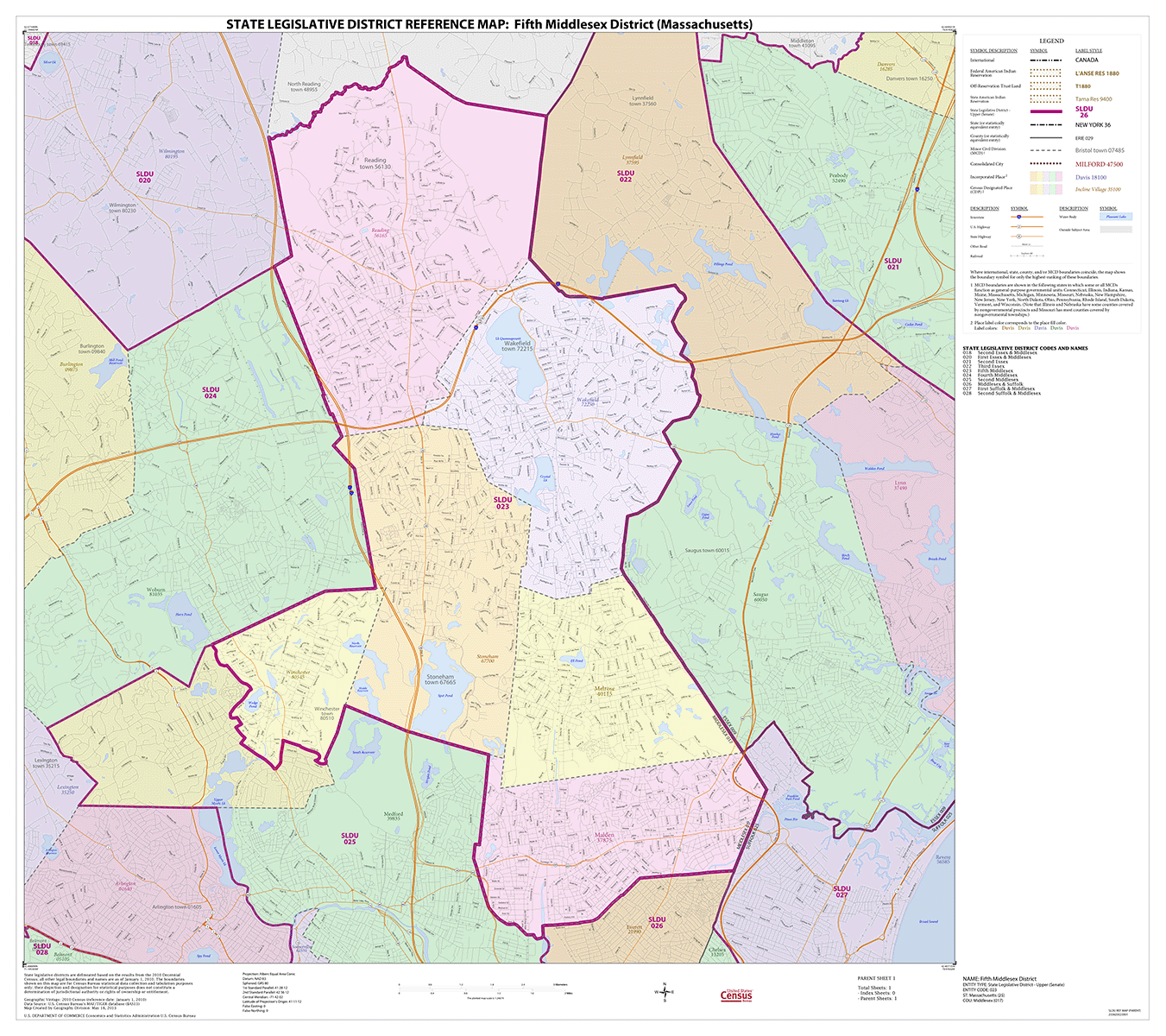
The Fifth Middlesex State Senate District
Source: US Census Bureau, 2018 State Legislative District Reference Maps
Each state Senate district includes approximately 175,000 people (compared to 44,000 in each state representative district). The Fifth Middlesex State Senate District includes all of Melrose, as well as Malden, Reading, Stoneham, Wakefield, and part of Winchester. It encompasses parts of the following seven state House of Representative districts:
- 9th Essex, which includes part of Wakefield, and is represented by Don Wong of Saugus;
- 20th Middlesex, which includes part of Reading, and is represented by Brad Jones of North Reading;
- 30th Middlesex, which includes the rest of Reading, and is represented by Richard Haggerty of Woburn;
- 31st Middlesex, which includes Stoneham and Winchester, and is represented by Michael Day of Stoneham;
- 32nd Middlesex, which includes Melrose, part of Wakefield, and part of Malden, and is represented by Kate Lipper-Garabedian of Melrose;
- 33rd Middlesex, which includes part of Malden, and is represented by Steve Ultrino of Malden; and
- 35th Middlesex, which includes the remaining part of Malden, and is represented by Paul Donato of Medford.
It is not uncommon for state representatives to run for a state Senate seat when one opens up. (Lewis himself was previously a state representative, as was Clark, who occupied the seat before Lewis.) Of the state representatives who represent parts of the Fifth Middlesex State Senate District, only Lipper-Garabedian, Day, and Ultrino would be eligible to run for the Fifth Middlesex seat, based on their town of residence. All three are registered Democrats.
When Lewis ran for state Senate in a special election in 2014, he defeated two other Democrats in the primary, and Melrose resident Monica Medeiros, who was running as a Republican, in the general election. (Medeiros, who at the time was serving as Alderman At Large in Melrose, earned 38 more votes among Melrose voters than Lewis did, although Lewis won the district overall, 52.7% to 46.3%.)
Since his election in 2014, Lewis defeated Republican challengers Vincent Dixon in 2016 (58% to 26%), Erin Calvo-Bacci in 2018 (63% to 31%), and Edward Dombroski in 2022 (61% to 35%). In 2018, Melrose resident Sam Hammar challenged Lewis in the Democratic primary, and won Melrose primary voters by 57% to 38%, although Lewis prevailed in the district as a whole, by 51% to 41%.
Running for State Senate can be an expensive venture. In 2022, when the Fifth Middlesex seat was last contested, Lewis' campaign spent $68,160 in the election year, and his challenger, Dombroski, spent $108,690. (For comparison, the two finalists in Melrose's most recent mayoral election, Jen Grigoraitis and Monica Medeiros Solano, each raised and spent over $50,000 in their race.)
Any residents of the Fifth Middlesex District who wish to run for State Senate need to submit 300 voter signatures to the local registrar of voters by the end of April. Candidates who are registered in a party will appear on the ballot for their respective party primary on September 1st; the winners of the primary elections, along with any unenrolled candidates, will appear on the ballot for the general election on November 3rd.