Construction Begins at 28 Greenwood Street
By Ellen Putnam
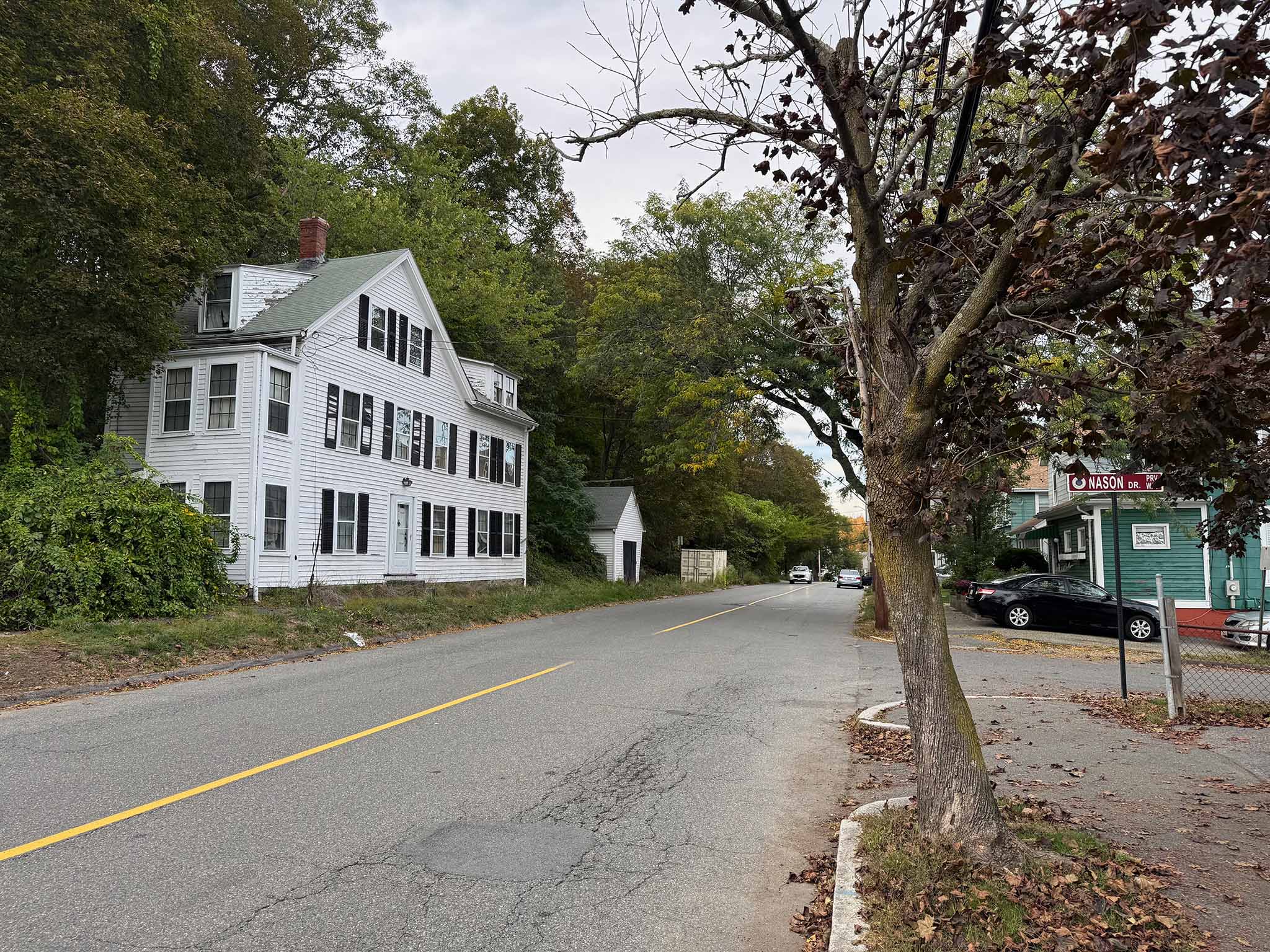
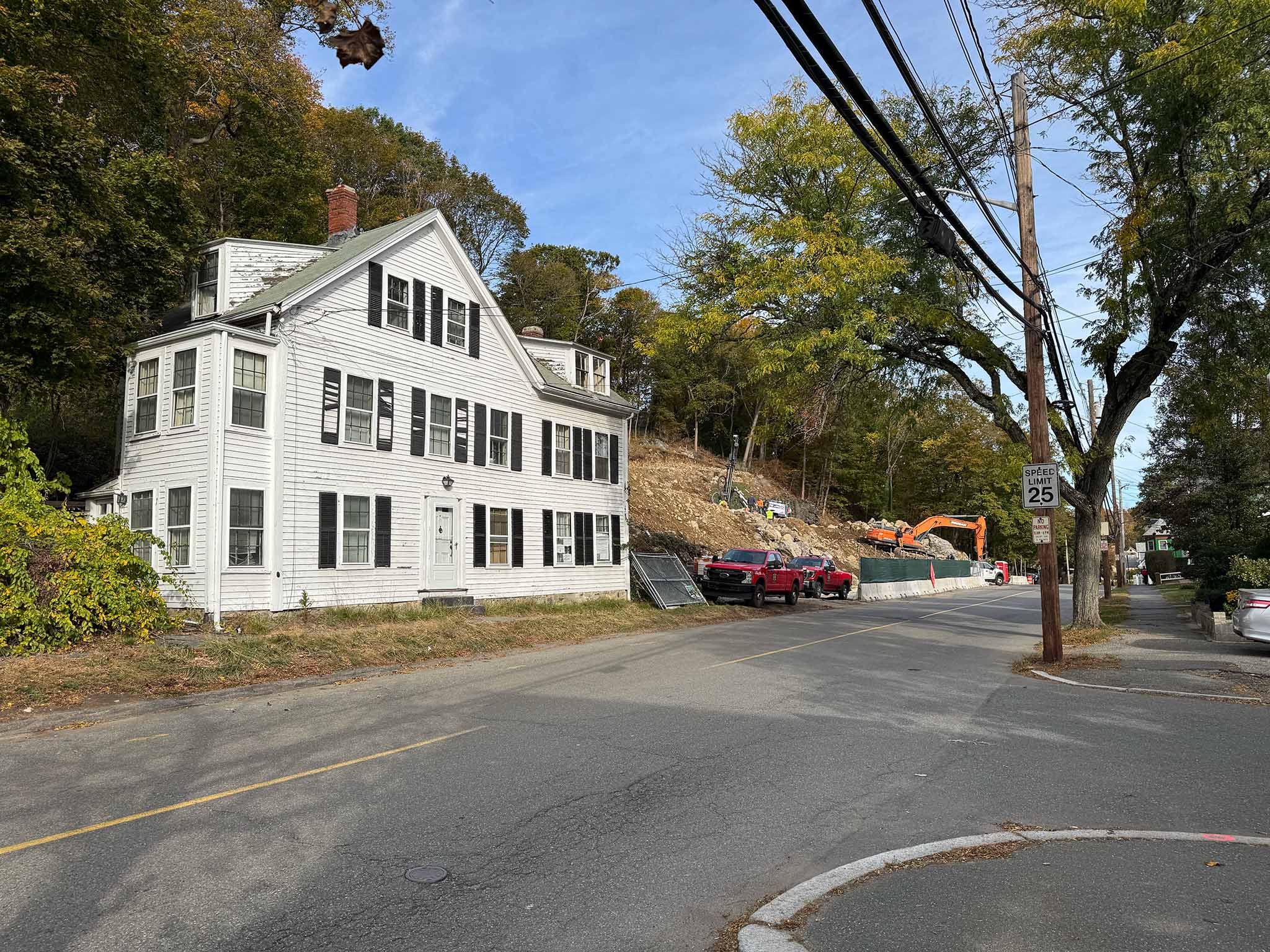
Above: 28 Greenwood last year
Below: 28 Greenwood this week
Construction on the long-discussed development at 28 Greenwood Street has begun with tree clearing and blasting to prepare the site for construction.
After three years of discussion, hearings, and a lawsuit, and with multiple changes to the size and scope, the project is now moving forward. This summer, Sean and Laura Szekely of Szecon Development went before the Zoning Board of Appeals (ZBA) to reduce the scope of the project from the originally planned 40 units to 12 units, three of which will be affordable. The project also changed from rental to unit ownership.
The project was filed under state housing law Chapter 40B, which effectively allows developers to bypass local zoning restrictions if they agree to include 20% or 25% affordable units in the project. Under Chapter 40B, the change to homeownership means that only the three affordable units will count toward Melrose’s affordable housing stock.
28 Greenwood Street will include ten three- and four-bedroom townhouses with two garage parking spaces in each, and two smaller units in the historic Weston-Wyman House.
Site clearing at 28 Greenwood began last month with the removal of dozens of trees from the site. Blasting - the controlled use of explosives to break and remove rock - began last week, and is expected to continue for approximately another six weeks with two blasts per day on many weekdays. Blasting is heavily regulated by the state, and a blasting company must receive a permit before blasting can begin. A fire detail is on site whenever blasting occurs and seismograph readings are taken after each blast to ensure that sound and vibration levels remain within legal limits.
While blasting has been used in a number of projects in the southern part of Melrose, including on Sylvan Street and in two of Szecon Development’s other projects on Dexter Road and Swains Pond Road, this is the first time the Melrose Highlands has seen significant blasting.
Throughout the discussion of the plans for 28 Greenwood, neighbors have expressed concerns about the potential for property damage caused by blasting, especially to the older houses that predominate in the neighborhood. By state law, the developer is required to pay for a pre-blast survey for any residents within 250 feet of the property where blasting is to take place. This would allow neighbors to receive compensation if any damage to their homes is caused by blasting. As a condition of approval of 28 Greenwood, Szecon agreed to extend pre-blast surveys to any property owners within 500 feet of the property who wanted a survey.
The Szekelys expressed expressed confidence in the safety of their blasting operations, noting that their initial plans for blasting, which were approximately five times larger than the current scope, had been approved as safe by independent geotechnical specialists. The smaller scale of the current project requires significantly less blasting and rock removal than the initial plans would have.
“Safety has always been our highest priority during any blasting operation,” they shared in a statement. “We recognize that blasting work can cause significant anxiety and disruption for nearby residents. We take all neighborhood concerns seriously and remain committed to operating with total accountability.”
The Szekelys also noted that their safety protocols involve using heavy mats to contain dust; deploying an aerial drone before each blast to confirm the site is clear; and sounding a warning horn, which is blown in a compressed time frame, in agreement with city officials, to avoid closing Greenwood Street for longer than necessary. The Fire Department reports that all seismograph readings taken so far have been below the legal limit.
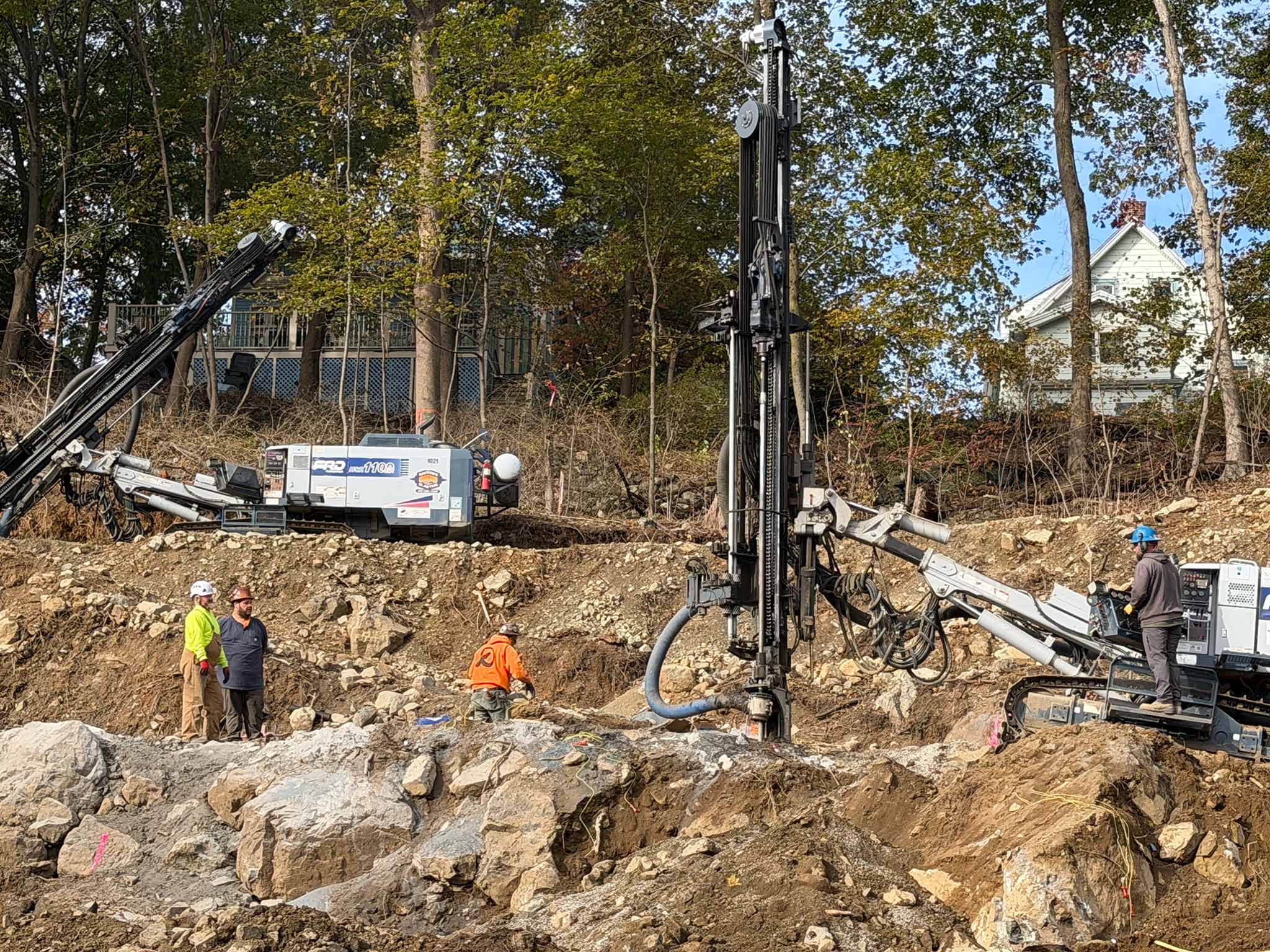
The blasting team prepares to set off a blast at 28 Greenwood
Photo Credit: Nancy Clover
But as notices for blasting went out late this summer, several residents expressed frustration with navigating the process of scheduling their pre-blast surveys and then accessing their results. “The city has really dropped the ball in terms of communication to residents in the Highlands,” said one neighbor. “We’ve been pestering the city and the Fire Department, trying to get information about when blasting would start, how often it would happen, what the procedures would be.”
Szecon maintains an email list providing weekly updates on the project. However, in terms of communication about the process from the city, Ward 1 City Councilor Manjula Karamcheti and City Councilor At Large Jason Chen, who lives in the neighborhood, appear to have become the main conduit of information for residents.
“Jason and Manjula are amazing,” said one resident, “They have really stepped up.”
But another resident pointed out, “Jason and Manjula don’t have a great way to reach everyone in Ward One, outside of Facebook. Where is the city support?”
“My priority has been to make sure that the claims process is well understood,” Chen noted. “People are already anxious, and when they’re not getting answers, they become more anxious.”
Different locations in the Melrose Highlands and surrounding areas are hearing and feeling the blasts differently. Neighbors who feel the blasts have described them as an earthquake, or a door slamming, or thunder. A close neighbor noted that blasts have knocked paintings askew on their walls. Residents have expressed concern for children and older adults, especially those with noise sensitivities, and for pets.
And while blasts often happen around 10am and 2pm, the unpredictability of the precise timing - especially because the warning siren is not always audible, such as when residents have their windows closed - makes it difficult for residents who struggle with the blasts to plan ahead. “A little communication could go a long way,” said one resident.
No official damage reports have been made so far, although at least one household indicated that they are preparing to report a crack in their wall that was observed after blasting began, and Karamcheti and Chen have both advised residents to inspect their homes weekly for possible damage.
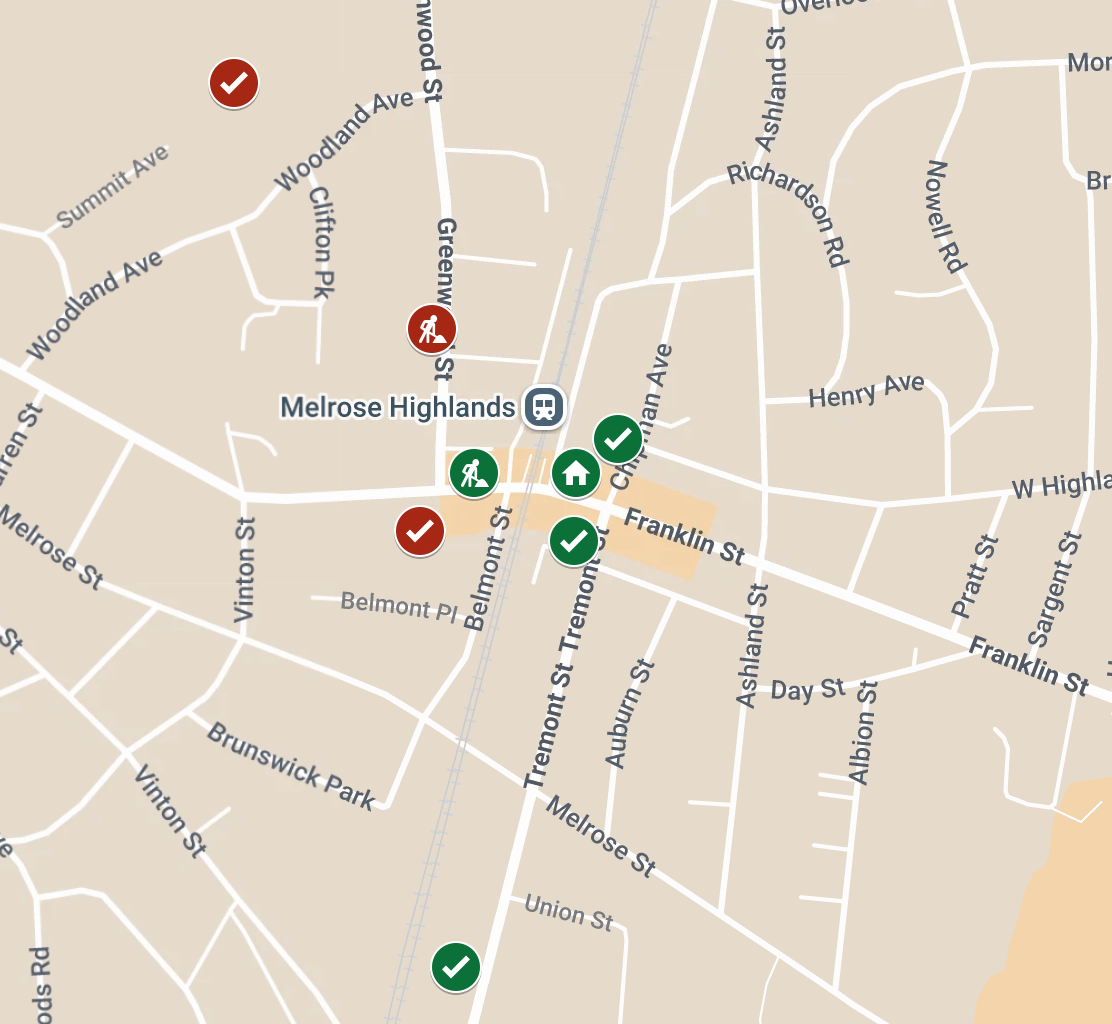
Red - 40B projects; ✔️ - approved but construction has not yet begun
Watch a video recording of a blast from this week.
One concern for many residents is that blasting at Greenwood Street feels like what Chen described as a “dry run” for the development at 35 & 55 Summit Ave, which is located at the top of the hill that 28 Greenwood is at the bottom of. That development was narrowly approved, three to two, by the ZBA this spring, and city officials have raised numerous concerns about the scale of the project relative to the size of the site, the developers’ plan for stormwater management, the site design making it difficult for emergency vehicles to turn around, and the impact of increased traffic on the nearby streets, which are steep and narrow.
“I’m very concerned about Summit Ave,” Chen said. “I’m nervous for the residents there.”
Residents have expressed concern about the loss of green space and tree cover at 28 Greenwood. A tree ordinance, which would require property owners to pay into a city fund for green spaces when they remove trees, is currently under discussion in Melrose, but a draft ordinance has not yet been presented to the City Council, and it would not apply retroactively.
Residents also expressed frustration with the peculiarities of Chapter 40B, due to which all of the disruption caused by construction at 28 Greenwood Street will result in minimal change to the city’s affordable housing count.
28 Greenwood is one of seven construction projects that have been permitted or built in recent years within a quarter-mile radius of the Melrose Highlands commuter rail station. Neighbors have expressed concerns during the approval process for many of these developments about increased traffic, pedestrian safety, and other problems caused by a sudden spike in density in the area immediately surrounding the train station.
“It’s a lot,” said one resident. “This is one of the oldest parts of Melrose, and it’s so much development in a small area. It’s really disruptive to the neighborhood.”
Another resident added: “Ward One is getting hammered.”